Space and Physics
 PUBLISHED
 3
3


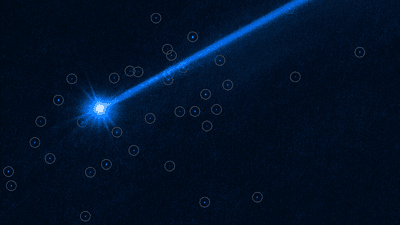


In 2022, NASA sent a spaceship to slam into an asteroid about the size of the Great Pyramid of Giza in an attempt to alter its course.
The mission was a success, and demonstrated that it is possible to redirect objects in space, great news for a planet that isn't a huge fan of being wiped out by asteroids. As well as successfully redirecting the asteroid Dimorphos, it sent huge boulders flying off from the loosely bound asteroid, ranging in size from 1 to 7 meters (3-22 feet) in diameter. These boulders are not moving at huge speeds relative to the parent rock – their average speed is 0.3 meters per second (0.7 miles per hour) – but that is enough to achieve escape velocity from Dimorphos.
Now, a team has looked at the orbital path these 37 objects will take over the next 20,000 years, discovering that the Earth is safe from impact. In a not-yet-peer-reviewed article published on pre-print server arXiv, the researchers found that the closest approach with Earth will happen in about 2,500 years, but the boulders will never be closer than 0.02 astronomical units (AU), with one AU being the distance between the Earth and the Sun. But Mars might not be so lucky.
"Numerical simulations show that all the boulders of the swarm will cross the orbit of Mars multiple times in the future 20 [thousand years]," the team wrote in the paper. "The simulated swarm is statistically representative of the set of 37 actual boulders recently discovered by using observations from the Hubble Space Telescope that were ejected during the impact of the DART spacecraft on Dimorphos. Therefore, due to the orbit crossings happening in the long-term evolution, it is possible that some of the boulders will impact Mars in the future."
These potential impacts happen twice around 6,000 years in the future, and twice again 15,000 years in the future. If the paths do cross – and there are a lot of variables that could alter the rock's path, such as the energy from sunlight – the team looked at what kind of impact the boulders would create.
"The condition of fragmentation, assuming a mean strength of about 1 MPa, is reached when the meteoroid hits the Martian soil without generating airbursts and with a speed slightly lower than the initial one because the Martian atmosphere is too thin to slow it down significantly. For this reason, in our case, a small, simple impact crater of about 200-300 m [656-984 feet] in diameter will be generated," the team explained.
"However, it cannot be ruled out that Dimorphos boulders have a strength lower than about 1 MPa. In this case, the meteoroids will fragment in the Martian atmosphere without reaching the ground intact, giving rise to a classic strewn field."
As well as assuring us that NASA has not accidentally sent meteorites at Earth during a test to redirect asteroids away from Earth, the study found further evidence that some meteorites that hit our planet could result from collisions between large and small asteroids, sending smaller rocks free from their clump.
The paper is published on pre-print server arXiv.
[H/T: National Geographic]