Space and Physics
 PUBLISHED


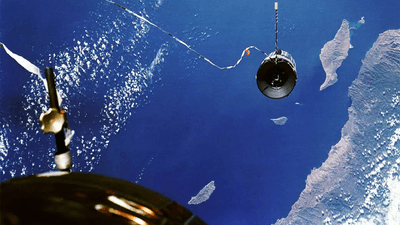


Sci-fi informs us, largely due to budgetary constraints preventing having all their actors float around the place, that artificial gravity is sort of just a button you press to turn the gravity on. But real artificial gravity – at least, of the kind we know of so far – is not like that. In fact, NASA conducted the first gravity experiment in space using a tether, generating a small amount of artificial gravity for two spacecraft.
So, what is artificial gravity, and how do we create it? Let's set expectations low up front, and if you have any problems with that, you can take it up with Einstein.
Albert Einstein's work showed us a whole host of things, a few of which are relevant. For example, his general theory of relativity showed us that gravity is the result of mass curving spacetime. That's not really relevant if you're trying to generate artificial gravity, unless you have a handy Earth-sized mass you can generate with your sci-fi button.
On the other hand, his equivalence principle is highly relevant, and makes generating artificial gravity as simple as attaching a rope between two spacecraft and firing off some thrusters. Which, to be fair, is still pretty darn complicated.
The equivalence principle suggests that there is no experiment that you can do that would distinguish between whether you were currently an astronaut in a spaceship being accelerated at 9.807 m/s² (32 feet per second squared), or sat on Earth in a box, like a Hobnob. Generate some acceleration, and you have yourself some artificial gravity. Accelerate using a thruster? You have yourself some artificial gravity there, good buddy, albeit don't think you're going to get a lot of it unless you're willing to expend unfathomable amounts of fuel.
Like I said, take it up with Einstein. Artificial gravity, simple though it is, would be really useful in long-term space missions, so spacefaring nations are interested in it, and have been for quite some time. Hypothetical designs, and more realistic sci-fi, have tended to stick to generating artificial gravity via our friend the centrifugal force, building a giant spaceship and rotating it very quickly.
It's a long way off, but it is a tested concept. On September 12, 1966, NASA launched the Gemini XI spacecraft for a three-day mission where it would rendezvous with the Agena Target Vehicle (ATV), a spacecraft left in orbit uncrewed and used as a docking target for various Gemini-era missions. As well as performing several spacewalks, on September 14, command pilot Charles "Pete" Conrad Jr and pilot Richard F. "Dick" Gordon attached a tether from their spacecraft to the ATV, before firing their thrusters.
"At 11:55 a.m. Conrad initiated a slow rotation of the Gemini capsule about the GATV which kept the tether taut and the spacecraft a constant distance apart at the ends of the tether," NASA explains. "Oscillations occurred initially, but damped out after about 20 minutes. The rotation rate was then increased, oscillations again occurred but damped out and the combination stabilized."
Skip to 27 minutes to see the experiment.
Firing their side thrusters, the two were able to get the two spacecraft to rotate with each other, doing a little space waltz and generating 0.00015 g. That's far too small to have been felt by the astronauts, with 1 g being Earth's average gravitational field. But objects were seen to move towards what had now been designated the "floor" of the spacecraft, whilst Gordon remarked "there is an artificial gravity field," adding, "it makes the camera move back very rapidly."
While artificial gravity generated via rotating spaceships sounds cool, there are a number of issues to work through, including your head and your feet feeling like they are in different gravitational fields.
"The smaller the space craft is, the faster it has to rotate, so if you're going to generate gravity, it's got to be done with a very large spacecraft that spins very slowly. The bigger the disk, the slower you can rotate it," John Page, a senior lecturer in the School of Mechanical and Manufacturing Engineering at the University of New South Wales, explained to ABC Science.
"This would avoid having a large gravitational difference between your head and your feet, which would result in blood accumulating at your feet and making you feel light headed."
But it's nice to know that way back in 1966, we had ourselves proof of concept.