Space and Physics
 PUBLISHED




On July 20, 1969, Neil Armstrong stepped out of the Apollo 11 Lunar Module "Eagle" and became the first human to set foot on the surface of another celestial body. It could have gone very differently, as he was meant to be asleep, and, if the Gemini VIII artificial gravity incident is anything to go by, he was meant to be dead.
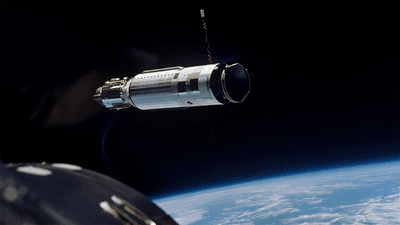
The Gemini VIII mission, though not as sexy as landing on an actual Moon, was a pretty exciting one at the time. Launching on March 16, 1966, it was intended to be the first ever docking of two US spaceships, and became the first mission to suffer a critical systems failure whilst in space. It was not supposed to be the first mission to experiment with artificial gravity, though they were about to conduct their own, uh, unplanned experiment on that front.
The first experiment with artificial gravity in space actually came later that year, involving two spacecraft and a tether. Though sci-fi and cartoons have taught us to expect a button that makes gravity switch on like a lightbulb, in real life, we are only aware of a couple of ways of creating artificial gravity.
According to Einstein's equivalence principle, gravity and acceleration are indistinguishable to an observer, meaning somebody in a windowless rocket accelerating at 9.8 meters per second squared (32 feet/s2) would be unable to tell whether they were in space, or sat in a box on Earth like the chumps in a cruel British TV show.
As a result, there are really only a couple of ways of producing artificial gravity in space: constantly accelerate (and good luck getting the fuel for that) or provide gravity via the centrifugal force. In the first planned experiment, the Gemini XI mission kept a rope taut between two spacecraft and began to slowly rotate them using thrust, generating a gentle 0.00015 g, with 1g being the average value of acceleration produced by gravity on Earth. Armstrong experienced much more than this when a thruster stuck in the "on" position caused them to tumble out of control.
"Approximately 7 h into the Gemini VIII mission following a planned 90° yaw maneuver, the combined spacecraft began an anomalous roll," a report looking into the stress the acceleration caused on Armstrong explains.
The spacecraft was still docked to the Agena Target Vehicle at the time, which Armstrong quickly corrected in order to figure out which vehicle was causing the issue. He soon realized it was his own.
"We've got serious problems here. We're tumbling end over end and we're disengaged from the Agena," he radioed down to NASA. "We're rolling up. We can't turn anything off. Continually increasing in a left roll."
At the peak spin, the spacecraft was rotating nearly once per second, setting the Guinness World Record for the "worst uncontrolled spin", and given that no other astronaut has been spun that fast since, it is clearly a contender for the record for artificial gravity experienced in space.
In danger of losing consciousness due to the forces acting on him, Armstrong was able to disable the Orbital Attitude and Maneuvering System thrusters, and bring the spacecraft back under control using the reentry attitude control thrusters. But unfortunately, by that point, he had used up around three-quarters of the ship's propellant, requiring an immediate return to Earth and ending the mission prematurely.
It could have been a lot worse, had Armstrong not acted so quickly.
"Assuming a 1.5-ft distance from the spacecraft center of rotation to astronaut chest center and a spacecraft roll rate of 50 rpm [revolutions per minute], an astronaut would experience a centrifugal acceleration through the upper body at chest center of approximately 1.28 G," the above paper explains, adding that at 75 rpm that goes up to 2.87 G, or nearly three times Earth's gravity. As well as this, the risks are complicated by the acceleration not being uniform, for example, with their hearts experiencing different Gs to their feet, adding to disorientation as well as unknown circulatory effects.
All in all, they concluded that "the Gemini VIII thruster malfunction created an inflight emergency that almost exceeded human performance tolerances to combined axis accelerations".
Fortunately, that didn't happen.
"The guy was brilliant. He knew the system so well. He found the solution, he activated the solution, under extreme circumstances," fellow astronaut David R. Scott later said of Armstrong's quick thinking. "It was my lucky day to be flying with him."
Without Armstrong's reactions, securing him a place in the Apollo program, he could have been killed by artificial gravity whilst in space, a truly absurd way to die.