Space and Physics
 PUBLISHED




In the last few years, papers published by the Vanishing & Appearing Sources during a Century of Observations (VASCO) project had a few UFO enthusiasts very intrigued, and scientists a little intrigued and very skeptical. A new paper, looking at archived astronomical plates from another observatory, appears to show support for the transient events they observed being real phenomena, or at the very least an error that was consistent across observatories before 1957.
The team, as the name suggests, was interested in identifying sources of light that have appeared or disappeared over the course of the last century. That's a pretty useful task for astronomers. In short, if a star appears or disappears suddenly, we can study whatever process is involved.
The study that had people intrigued looked at old observations at the Palomar Observatory Sky Survey (POSS-I), which scanned the skies from November 19, 1949, to April 28, 1957.
"These short-lived transients (lasting less than one exposure time of 50 minutes) [...] are absent in images taken shortly before the transients appear and in all images from subsequent surveys," the team wrote in a 2025 study. "[In] some cases multiple transients appear in a single image, exhibiting characteristics not easily accounted for by prosaic explanations (e.g., gravitational lensing, gamma ray bursts, fragmenting asteroids, plate defects)."
What's so intriguing about that? Surely the photographic plates merely picked up an object, such as a satellite, as it passed overhead and reflected light? Well, looking at the dates, no. Sputnik, the first satellite launched into space, did so on 4 October 1957, after these observations were taken.
In the same study, the team presented further puzzling results: a small correlation between transients and nuclear tests, with transients 45 percent more likely to be observed on dates within nuclear test windows. As well as this, the team found a smaller association between unidentified aerial phenomena (UAP) sightings and transient observations, with the association being stronger when multiple transients were captured.
While the team suggested a few hypotheses, one of them pricked up the ears of unidentified flying object (UFO) and UAP enthusiasts. The first, largely drawn from UFO lore, is the highly unlikely hypothesis (given that we have no evidence of alien life, let alone alien life that can visit us) that these are real objects caught on photographic plates, and that they may be UAPs drawn to Earth by nuclear weapons testing. A second, more plausible hypothesis (though without stiff competition) is that they have picked up some unusual and unknown atmospheric phenomenon associated with nuclear weapons tests.
"While the latter is potentially plausible, effects in the atmosphere (rather than geosynchronous orbit) would be likely to result in a streak on the image over the 50 [minute] exposure, yet all transients appear as distinct point sources rather than streaks," the team wrote, adding, "regardless of what transients are ultimately determined to be, our results add to growing evidence supporting the interpretation of transients as real observations, rather than as emulsion defects."
A follow-up study added to the intrigue. The team found that these transient events did not occur as much when the observations were taken of an area in the Earth's shadow. If these were emulsion defects or plate errors, the team explains, there would be no reason why they should avoid Earth's shadow. Real objects would be seen less in Earth's shadow, with less light to reflect down to our telescopes.
So, where are we now? It all sounds fairly convincing that there is a real phenomenon, but many astronomers are not convinced. Another preprint study, submitted in January 2026, criticized the lack of microscopic analysis of the plates, for example.
"We find that the reported correlation between the timing of feature observations and nuclear tests becomes insignificant after properly normalizing by the number of observation days, and is almost completely determined by the observation schedule of the Palomar telescope," that study added. "We uncover important inconsistencies in the definitions of the datasets used in these studies, as well as the use of unvalidated datasets containing catalog stars, scan artifacts, and plate defects."
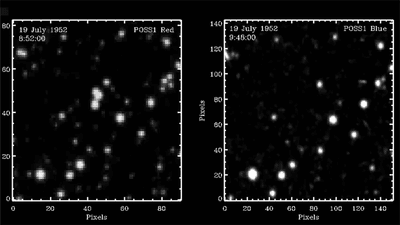
In the latest preprint study, researcher Ivo Busko attempted to look at photographic plates from other observatories in the pre-Sputnik era, to see if similar phenomena were captured there, settling on observations from the Hamburg Observatory. Looking at observations taken around 30 minutes apart of the same sky regions, Busko identified 35 of these events that he believes are similar in nature to the Palomar observations.
"We obtain initial results that [seem to] independently confirm the presence of such transients," the study reads. "While the work is still ongoing, one notable result is the emerging consistency with previous findings from the VASCO project, particularly regarding the expected observational signatures of sub-second optical glints in photographic plates. Specifically, the detected events exhibit a systematically narrow FWHM compared to stellar point spread functions, which is consistent with their interpretation as extremely short-duration flashes."
While an astronomical mystery is always intriguing, it's still not time to get too excited. Flashes on a plate do not mean aliens were visiting us during nuclear testing, with explanations like high altitude balloons and plate errors still being more likely, and atmospheric phenomena resulting from nuclear tests also being possible. The Hamburg Observatory uses "very similar optical and mechanical characteristics" as one telescope at Palomar, making it still possible that what the teams have discovered is an interesting error in how the observations were taken.
In short, further study is needed, especially before we conclude that aliens were whizzing around above us as we bombed the crap out of the Earth below.
The study is posted to the preprint server arXiv.