


 Space and Physics
 PUBLISHED




In November 2024, Todd Humphreys, Professor of Aerospace Engineering at the University of Texas at Austin, received an unusual tip off, telling him to look at data from a network of GPS monitoring stations from very specific times, collected in 2021.
As Veritasium explains in a new video, this sort of tipoff didn't seem like it would contain anything too interesting. These monitoring stations capture signals given off by GPS satellites, and compare the signal strength to background noise, and with the data publicly available and sitting there for years, surely someone would have spotted anything unusual within it.
But looking at the data, Humphreys and his students did find some pretty unusual features within it. At certain times, there were short and very sharp drops in signal strength, along very specific frequencies. Looking through more of the data, they found a lot more of these events, always with the same distinct pattern.
In a new paper that has not yet been peer-reviewed, the team identified 75 days where these signal drops occurred, over wide areas of Europe.
"This effect was being felt all the way across Europe, all the way to the north, to Svalbard, to the south, to Spain, all the way to Canada in the west, as far east as eastern Poland," Humphreys explained to Veritasium.
"And in fact, it had a distinct pattern across Europe to where it looked like the blast center was in Poland or Kaliningrad in that area."
Global Positioning System (GPS) jamming is not that unusual, and has certainly been taking place in the Middle East in recent months. But this sort of jamming was unusual. Given the wide area that it covered, with several satellites being jammed simultaneously, this wasn't jamming that was coming from the ground.
The interference did not match the sort of interference that comes from space weather either, as that covers a wide range of radiofrequencies, whereas this interference was very narrow, lasted less than 10 seconds, and centered around 1,577.5 megahertz, right where GPS signals sit.
As well as this, the Sun tends not to schedule space weather for weekdays.
"Notably, these [interference events] predominantly occurred during business days and business hours (UTC time), which suggests human involvement," the team writes in their paper, highlighting that they tended to occur the most on Tuesdays, Wednesdays, and Thursdays. "A purely random phenomenon would tend to exhibit a temporally uniform distribution."
Whilst that's a pretty compelling sign that the jamming was of human origin, the team needed to find the source of the interference by combining a number of techniques, outlined by the team:
"1) a simple technique that finds all satellites satisfying a given elevation mask (e.g., 0◦) for each station detecting the interference;
(2) a more advanced technique based on each station’s detection statistic rather than on a binary decision, and on estimation of unknown parameters such as the interference transmit power; and
(3) a technique based on time-difference-of-arrival measurements made possible by capture of wideband (e.g., 60-MHz) raw samples during an interference event."
Through these techniques, the team identified satellite Cosmos 2546 (or Kosmos 2546) as one of the sources of the interference.
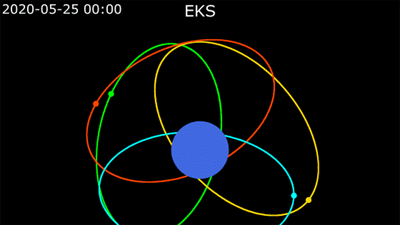
"Further analysis pointed to the Russian Edinaya Kosmicheskaya Sistema, an early warning constellation to which Cosmos 2546 belongs, as collectively responsible for the wide-area transient interference causing GNSS degradation across Europe since 2019," the team concludes.
The satellites making up this ballistic missile-detecting constellation were first launched in 2015, with further launches in 2017, 2019, and 2020, when Kosmos 2546 was put into orbit. Though not explicit, and further investigation as well as peer review is needed, it appears that Russia may be behind the jamming of GPS over Europe since 2019, and they did so from space.
Whilst the motivation for the jamming may seem obvious, there are still a few mysteries to clear up.
"Although the overwhelming majority of interference events saw receivers in the Baltic region impacted most, day 204 of 2020 exhibited a distinct interference pattern compared to other days. On this day, there was progressive movement in the geographic center of interference over multiple events, starting in the Baltic Sea and then moving into Germany and on to the Norwegian Sea, all over a 20-minute interval," the team adds.
"This deviation may be attributed to satellite motion, to a change in the interference source’s beam pointing vector, or to multiple active satellite sources."
The study is available on the preprint server arXiv.


