Nature
 1
1



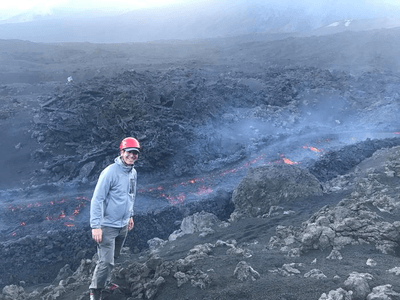


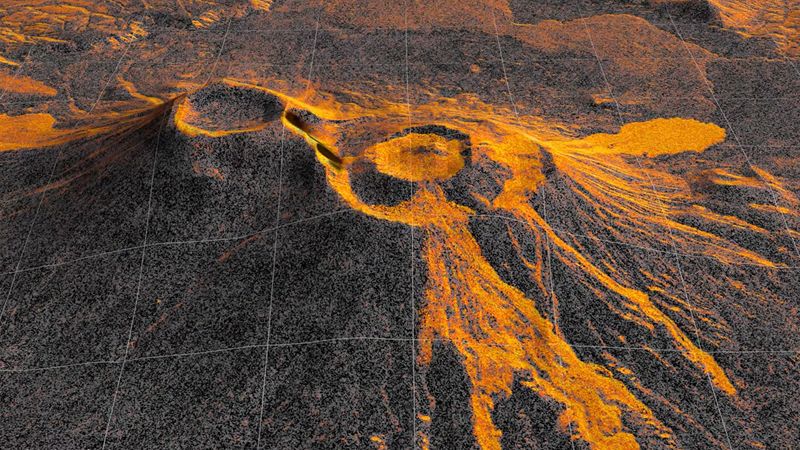
Researchers have come up with a new explanation for the origins of Mount Etna, which remains Europe’s most active volcano despite being more than half a million years old. The work could improve our understanding of why Etna erupts several times a year when most volcanoes slumber for years or decades between eruptions.
Almost all the volcanoes in the world have been attributed to one of three processes, each of which brings melted rock from the mantle to the surface as magma.
- Widening separations between tectonic plates allow mantle material to rise through the gap: usually this occurs in the deep ocean, but occasionally it reaches the open air.
- When one plate moves over another, water is transported down, lowering the local melting point of the mantle and generating explosive volcanoes like those of the ring of fire.
- Mantle hotspots weaken the crust above until the mantle can break through, producing volcanic islands like Hawaii or provinces like Afar.
Mt Etna’s magma has a chemistry similar to that found at mantle hotspots, but there is no hotspot nearby. Instead, there’s a plate boundary with a subduction zone, which usually produces very different magma. That’s good for the population of Sicily, since it means frequent small eruptions rather than rare but far more damaging ones. On the other hand, it’s been a problem for volcanologists.
Sébastien Pilet at the University of Lausanne and his co-authors think the volcano’s history holds clues.
The team studied the chemistry of lava flows over Etna’s long lifespan, showing that these became more alkaline over the past 250,000 years, and, therefore, more similar to hotspot volcanoes.
That indicates the magma came from the upper mantle. Instead of being filled with magma shortly before eruptions, like other volcanoes, the team thinks Etna’s depths get frequent small infusions direct from the mantle.
Sometimes, the jostling of the African and Eurasian tectonic plates drives magma towards the surface through fractures in the Eurasian plate, which is cracking as the African plate slides beneath it. Etna sits atop a concentration of these fractures, drawing magma from up to 50 kilometers (30 miles) away.
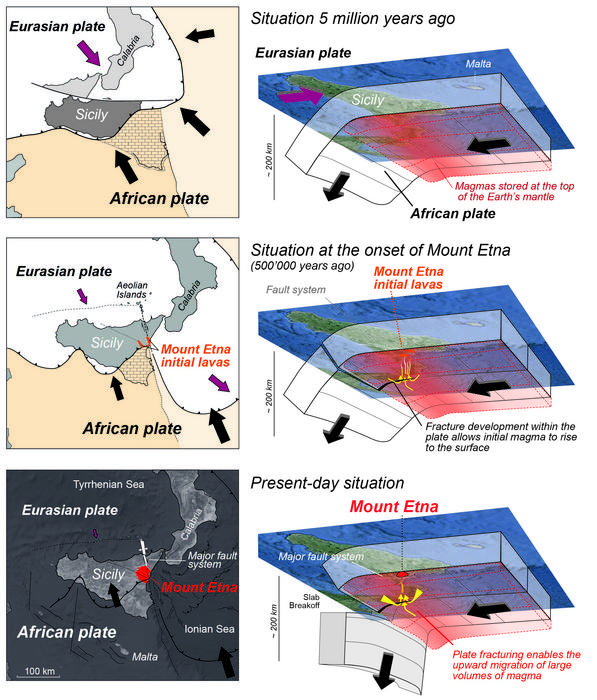
Twenty years ago, geologists described a rare fourth type of volcano, known as “petit-spots” off the coast of Japan. As the name suggests, these are small and have only been found on the seabed, but they’re thought to be driven by the same process now proposed for Etna – cracking of a plate as it encounters another, letting magma through.
“Our study suggests that Etna may have formed through a mechanism similar to the one that generates petit-spot submarine volcanoes,” Pilet said in a statement. “This is unexpected, as such processes had previously only been observed in very small volcanic structures, typically rising no more than a few hundred meters. Mount Etna, by contrast, is a large stratovolcano, whose activity began around 500,000 years ago and which now towers more than 3,000 meters (10,000 feet) above sea level.”
Changes in the rate at which Etna releases lava are a product of the movements of the African and Eurasian plates and their bumping against each other, the authors propose.
The authors describe Etna as a “leaking pipe of magmas from the low velocity zone,” but this pipe leaks upwards. No unusual mantle composition is required to explain Etna’s unique activity, the authors argue, only the complex behavior at the nearby plate boundary.
The study is open access in JGR Solid Earth.