Space and Physics
 PUBLISHED


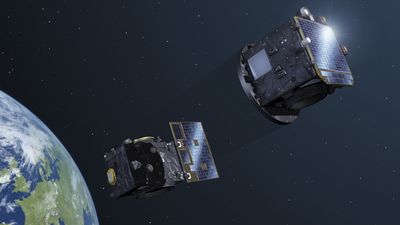


The European Space Agency (ESA) has managed to re-establish contact with one of the two Proba-3 spacecraft, after losing it back in February. This paired mission is studying the Sun like never before, thanks to a never-before-attempted flying formation. The loss of one of them would have ended the mission for good, so re-establishing contact is very good news.
The solar corona, the atmosphere of the Sun, remains in many aspects a mystery. The best time to study it is during an eclipse, when the light of the Sun is blocked by the Moon. Eclipses are fairly rare and often in inconvenient places, so astronomers have had to come up with coronagraphs – a little disk put in front of a solar telescope to stop sunlight.
The farther away the coronagraph is, the deeper you can probe the corona. This is why ESA came up with Proba-3. One spacecraft is called the Occulter and does the job of casting the shadow, while the other is the Coronagraph, orbiting precisely behind its companion at about 150 meters (492 feet).
On Valentine's Day weekend, an anomaly triggered a series of commands on the Coronagraph spacecraft that led to it losing orientation. The mission team was unable to place it into safe mode. The solar panels stopped facing the Sun, and the batteries began to discharge quickly. Minimal electronics remained active and data transmission to the ground was interrupted.
The team at ESA's ground station in Villafranca, Spain, did not give up and this week received telemetry from the Coronagraph. They were able to re-establish contact, placing the spacecraft in the right orientation to receive sunlight and putting the whole system in safe mode. Director-General of ESA Josef Aschbacher described it as a "miracle" during a press conference.
“Hearing back from the Coronagraph is amazing news, and a great relief!” Damien Galano, Proba-3 Mission Manager, said in a statement. “Since the issue was detected a month ago, the mission team, operators and our industry partners have been working tirelessly to get the spacecraft back.
“When we got the call from the operators at Villafranca, the excitement in the team was palpable. But the hard work is not over yet – we need to carefully look at the data before we take any further steps.”
Most of the spacecraft's systems have not worked and have been very cold for over a month. What you do not want to do is act as if nothing has happened. The recovery might be slow, but let’s hope smooth for what's considered a very exciting and important mission.