Space and Physics
 PUBLISHED
 1
1


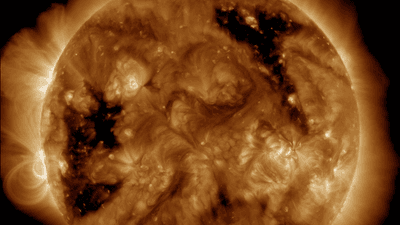


Ok, so you've decided to dive into the Sun. That's an interesting life choice (maybe you could take up knitting?), but putting that aside for now, how far into it will you "sink" before you can't sink anymore?
First up, how do you get to the Sun? While you might think the best way is to point your rocket at the big yellow burny thing and fire away, that would result in a wild miss. What you need to do instead, perhaps using gravity assists from a few helpful planets, is to cancel your sideways velocity.
"Our planet is traveling very fast – about 67,000 miles per hour – almost entirely sideways relative to the Sun," NASA explains. "The only way to get to the Sun is to cancel that sideways motion."
Assuming you've got all that figured out, next you should know the obvious: You will be needing a futuristic shielding device, capable of withstanding temperatures you are incapable of imagining, before you can attempt to swim inside the Sun.
"The hottest part of the Sun is its core, where temperatures top 27 million °F (15 million °C). The part of the Sun we call its surface – the photosphere – is a relatively cool 10,000 °F (5,500 °C)," NASA explains. "In one of the Sun’s biggest mysteries, the Sun’s outer atmosphere, the corona, gets hotter the farther it stretches from the surface. The corona reaches up to 3.5 million °F (2 million °C) – much, much hotter than the photosphere."
Assuming you also have that all figured out, now we can talk density. Even with your sci-fi shield suit (why didn't you pay extra for adjustable buoyancy? It was only 100 Space Bucks) you are not going to sink at the Sun's core.
"The density of the Sun’s core is about 150 grams per cubic centimeter (g/cm³)," NASA explains. "That is approximately 8 times the density of gold (19.3 g/cm³) or 13 times the density of lead (11.3 g/cm³)."
But in the Sun's corona, or outer atmosphere, you'd sink for sure. In the corona the density of particles is around 10-16 grams per cubic centimeter. That's a tiny density, and far less dense than the Earth's atmosphere. And you'll notice how you aren't currently floating around on the Earth's atmosphere right now. You would "sink" easily through this part of the Sun, and through the convection zone.
You'd actually make it surprisingly far into our star before you stop sinking (again, assuming you have a sci-fi suit with powers akin to magic).
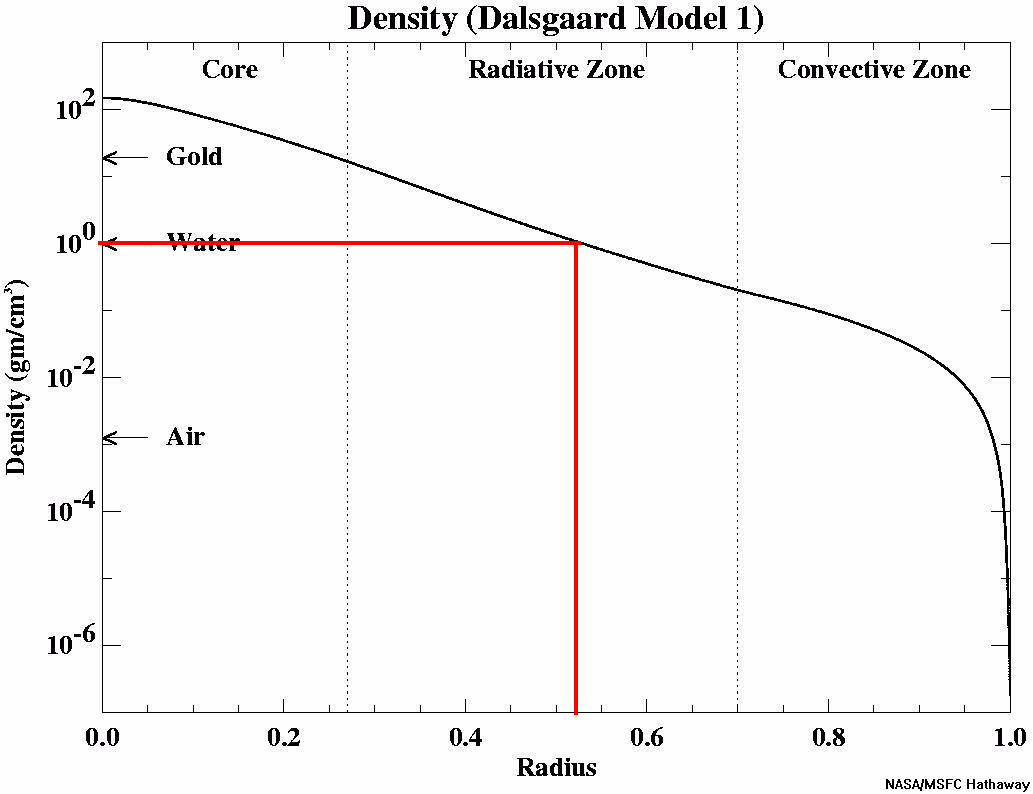
Humans (about 985 kg/m3) are roughly the same density as water (1,000 kg/m3). So where inside the Sun is the density roughly the same as water? That's way inside the radiative zone, where the density varies wildly from top to bottom.
"Although the photons travel at the speed of light, they bounce so many times through this dense material that an individual photon takes about a million years to finally reach the interface layer," NASA explains. "The density drops from 20 g/cm³ (about the density of gold) down to only 0.2 g/cm³ (less than the density of water) from the bottom to the top of the radiative zone. The temperature falls from 7,000,000° C to about 2,000,000° C over the same distance."
The point where you would begin to float, at around water's density, would be nearly halfway into the radiative zone.
From there, the density would get thicker until you could no longer sink into the Sun. Contrary to the myth perpetuated by Scrooge McDuck, you can't swim through gold – nor nightmarishly hot plasma that is the same density as gold.