Space and Physics
 PUBLISHED



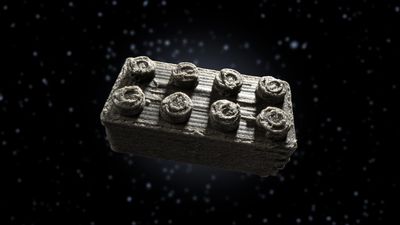


One of the biggest goals for the future exploration of the Moon is to build a permanent base using material found there. Scientists have experimented with creating bricks using different materials, including blood and potatoes. European Space Agency (ESA) researchers have just tested a different method. They made 3D-printed LEGO bricks out of a billions of years old celestial material, and they work just like regular LEGO bricks (which means yes, they'd still hurt if you stepped on one).
The surface of the Moon is covered by regolith, soil made of sharp rocky material, the result of billions of years of meteor impacts and the effects of charged particles from the Sun and beyond. We don't have that here on Earth, but we can simulate it, which was mixed with a bio-based biodegradable polymer known as polylactide.
There was a third ingredient that made the concoction more realistic. The closest thing to regolith we have on Earth is meteorite dust so they pulverized a 4.5 billion-years-old meteorite that landed in North Africa in 2000 and added it to the mixture. The result was a sturdy brick that comes in a stylish space gray.
The space LEGO bricks behave just like regular ones, clicking together even though the 3D printing process adds irregularities that regular bricks do not have. However, the experiment shows that it is certainly possible to create structures from materials found on the Moon that can interlock, providing a huge level of versatility when considering building bases on a potential future mission.
"Nobody has built a structure on the Moon, so it was great to have the flexibility to try out all kinds of designs and building techniques with our space bricks. It was both fun and useful in scientifically understanding the boundaries of these techniques," ESA Science Officer Aidan Cowley said in a statement.

“My team and I love creative construction and had the idea to explore whether space dust could be formed into a brick similar to a LEGO brick, so we could test different building techniques. The result is amazing, and while the bricks may look a little rougher than usual, importantly the clutch power still works, enabling us to play and test our designs,” Cowley expressed in a second statement.
The experiment is now going to be used to promote science and engineering to younger people. The bricks will be on show until September 20, in many LEGO Stores across the United States, Canada, Europe, and Australia.
"It's no secret that real-world scientists and engineers sometimes try out ideas with LEGO bricks. ESA's space bricks are a great way to inspire young people and show them how play and the power of the imagination have an important role in space science, too," Emmet Fletcher, Head of ESA's Branding and Partnerships Office, said.