Nature
 PUBLISHED


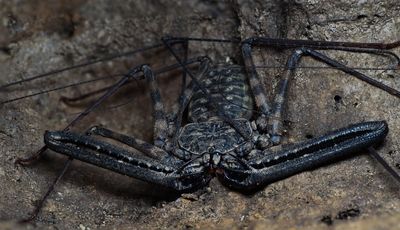


Even for nature lovers, there are some animals out there that give even the most dedicated naturalist the heebie-jeebies. Tailless whip scorpions might just do the trick with their impressively prehistoric-looking bodies and frankly too many limbs.
What is a tailless whip scorpion?
Tailless whip scorpions, also known as whip spiders, belong to the order Amblypygi and have over 200 species. The name Amblypygi actually means “blunt rump” in reference to their lack of a tail. Tailless whip scorpions are neither spiders nor scorpions, but they are considered arachnids, in the class Arachnida. They are an ancient order and are thought to have been roaming around since the Devonian period around 416 million years ago, though relatively few species have survived to the modern age. They are often confused with whip scorpions or vinegaroons that belong to the order Uropygi. Unlike other arachnids, tailless whip scorpions only possess six legs for walking and can move sideways like a crab.
The other front two legs are elongated to become antenna-like and are highly sophisticated sensory structures, they can be around two and a half times the lengths of the other legs and are sometimes known as “whips”. These are used to tell the animal about its environment and even pick up the vibrations of their prey – this is especially useful since most tailless whip scorpions have very poor eyesight or are blind. The tailless whip scorpions also have spiny pedipalps which they use to capture their next meal.

Where do tailless whip scorpions live?
The tailless species have a wide distribution and live in North and South America, across Africa, and Asia. Their flat bodies allow them to creep into crevices and beneath boulders during the day, and then emerge at night to hunt.
What do tailless whip scorpions eat?
These creatures have very strong jaws but do not produce venom and are harmless to humans. Because of this, they are often kept as pets. In the wild, they have a varied diet and will feed on large insects, worms, crustaceans, and even small vertebrates. They can also engage in fierce fights over territory that can see the loser eaten by the victor.
How do tailless whip scorpions breed?
Courtship between a male and a female begins with a slow dance that can last several hours. A capsule full of sperm called a spermatophore is placed on the ground by the male for the female. The females can lay up to 60 eggs and will even carry their offspring for several days after hatching. It is thought that in the wild the animals have a lifespan of between 5-10 years, but have been known to live much longer in captivity.