Nature
 PUBLISHED


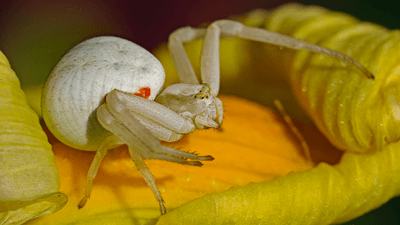


Meet the crab spiders, some of the world’s coolest-looking mashed-up animals (not to be confused with spider crabs). While they are technically spiders and not scary crab-spider hybrids, you can definitely see where the name comes from when you look at them.
Overview
Crab spiders typically belong to the family Thomisidae, which consists of around 2,100 species. While the species are spread all across the world, roughly 125 species live in the United States. Like their namesake, these spiders often walk sideways or backward according to Britannica, with their front two pairs of legs longer than the back pairs.
Goldenrod crab spider
One interesting crab spider species is the goldenrod crab spider also known as the flower crab spider (Misumena vatia), which is nicknamed the “white death spider”. It can be seen between May and August in the United Kingdom and it is the only member of its genus to live there.
These spiders don’t spin webs, instead lying in ambush often in the tops of flowers for bees or moths to feed on. The female is able to change her color but the males, which are smaller, cannot according to the Wildlife Trust.
Females are able to change between white and yellow based on a chemical called guanine, which is mostly seen in feces. On a yellow background, the female can synthesize a yellow pigment between the guanine and her cuticle, over time this changes her appearance from white through cream to bright yellow, which can then be broken down and reversed. It thought this ability might make them harder to see for predators and prey species to spot, writes the British Arachnological Society.
Hunting
These spiders rely on speed, strength, and venom to catch their prey, and can even catch insects many times larger than themselves. Crab spiders lack the teeth on their jaws, known as chelicerae, which are seen in other species, and instead use their digestive juices to liquidize their prey and suck out the innards.
Other interesting species
The bird dung spider (Phrynarachne ceylonica) is also a crab spider species that, unsurprisingly, mimics the appearance of bird dung. They even go so far as to smell like bird droppings too.
“Many people would not be able to even distinguish a spider from a bird dropping,” Stano Pekar, a zoologist at Masaryk University in the Czech Republic, told the New York Times. “I mean, they really have a very good masquerade.”

Again this is thought to both attract prey species like flies, but also serves to hide them from predatory species like birds.“I think in the future we will see many more cases where both the coloration or the pattern will be both defensive and offensive,” finished Dr Pekar.
One other species, the crab spider Thomisus onustus, was found in a 2018 study to reduce the number of bee visits to a flower, but also benefit the plants by feeding on species that were florivores.
It seems these crab spiders, just like their name suggests, are good at doing two things at once.