Health and Medicine
 PUBLISHED





Anyone with celiac disease knows that gluten is hard to avoid – but for those with the autoimmune condition, it’s essential that they do. Food is the obvious source of potential exposure, but there are others that you may not even consider. What happens, for example, if your significant other eats something gluten-rich before they kiss you? Scientists have now quantified just how much gluten can be transferred this way – and, reassuringly, found a simple step that can cut the risk.
Celiac disease affects about 1 percent of the population. It’s not a food allergy, and it’s not the same as an intolerance to gluten. In celiac disease, the immune system sees gluten as a threat and goes on the attack, damaging the small intestine in the process and causing symptoms like stomach pain, constipation, anemia, unexplained weight loss, and even infertility.
The only treatment is to completely cut out gluten, since even a small amount will trigger this damaging cascade.
Many celiacs experience anxiety around accidental exposure to gluten. It can make things like vacations and eating out fraught with worry, but this can also extend to dating and relationships. One common fear is that kissing a partner who has consumed gluten could lead to harmful exposure.
A newly published study led by a team at Columbia University is the first to quantify the risk of gluten exposure through kissing.
The scientists tested gluten transfer in 10 couples where one partner has celiac and one doesn’t. Specifically, they were looking to see whether any amount of gluten would actually be passed to the celiac partner via open-mouthed kissing with saliva exchange, and if so, whether there was a meaningful risk to the person.
There were two different kissing experiments. In both, the non-celiac partner was asked to eat 10 saltine crackers, containing 590 milligrams of gluten. In the first experiment, they then kissed their partner after waiting five minutes. In the second, they drank roughly 120 milliliters (4 ounces) of water after munching the crackers and before the kissing.
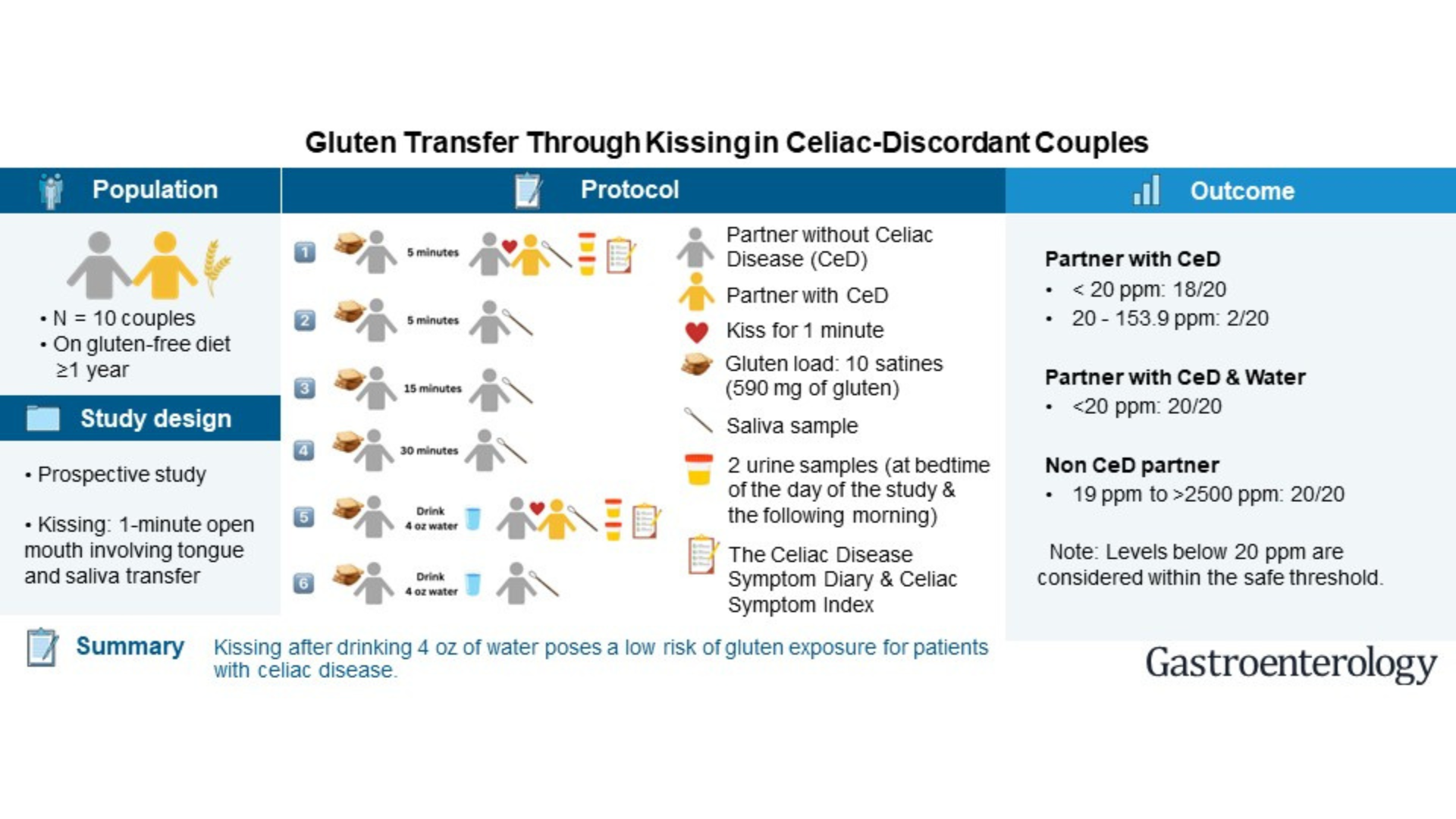
In findings that will be reassuring for those with celiac disease, the gluten levels detected in saliva after eating the saltines were found to be below 20 parts per million in 90 percent of cases. That’s the threshold set for a product to be labeled as gluten-free.
After drinking water, none of the saliva samples tested above this threshold – 60 percent of them contained no detectable gluten at all.
In every case, the total amount of gluten ingested by the celiac partner was negligible. However, drinking water after eating something containing gluten appears to be a simple way to almost completely neutralize any risk there may have been.
“We found that transfer of gluten through mouth kissing can occur but is unlikely and can be minimized further by a glass of water before the kiss,” the authors conclude in their paper. “We hope this can alleviate some of the social anxiety, especially as it relates to physical intimacy.”
Being told that you will need to follow a strict gluten-free diet for the rest of your life can presumably be a daunting experience. That won’t be helped by some of the “advice” the authors say they’ve seen online, things like insisting your partner brush their teeth after consuming gluten, which they describe as “not backed by any evidence-based studies”.
With 39 percent of participants in one study saying they were hesitant about kissing, this research may go some way towards putting people’s minds at rest.
The study is published in the journal Gastroenterology.
The content of this article is not intended to be a substitute for professional medical advice, diagnosis, or treatment. Always seek the advice of qualified health providers with questions you may have regarding medical conditions.