Nature
 PUBLISHED
 12
12


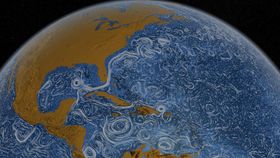


New research shows the large ocean current system that includes the Gulf Stream is losing stability – potentially approaching a tipping point that will have knock-on effects throughout our planet. The cause of this trend is complex, but all major factors are clearly linked to one thing: human-caused climate change.
If you think this sounds exactly like the premise of the disaster movie The Day After Tomorrow, you're not wrong. However, before you start planning for the apocalypse, it's still unclear how close this tipping point is, and it's uncertain what impacts we could see if this collapse occurs.
In the journal Nature Climate Change, Niklas Boers from the Potsdam Institute for Climate Impact Research, Freie Universität Berlin, and Exeter University examined the health of the Atlantic Meridional Overturning Circulation (AMOC) – finding new evidence it's undergoing a worrying slowdown caused by loss of stability.
The AMOC is like Earth's jugular vein. The gargantuan ocean current in the Atlantic transports warm water from the tropics northward at the ocean surface, and cold water southward at the bottom of the ocean. One arm of this current is the Gulf Stream, which plays an important role in the climate of multiple regions.
The stability of the AMOC has significantly declined over recent decades, Boers' analysis suggests. Previous work revealed that the AMOC is currently at its weakest in over a millennium, but new observations and modeling show that this weakness is actually a result of declining stability. This means the vital ocean current system could be approaching a critical threshold – beyond which the circulation system could collapse.
"The findings support the assessment that the AMOC decline is not just a fluctuation or a linear response to increasing temperatures but likely means the approaching of a critical threshold beyond which the circulation system could collapse," Boers explained in a statement.
A number of factors likely played a role in this – all linked to human-caused climate change – including freshwater inflow from the melting of the Greenland ice sheet; melting sea-ice; and river run-off from excess rainwater, stormwater, and meltwater.
The impact of a possible collapse is currently hard to determine, but it’s clear the AMOC directly influences the climate across much of the east coast of North America and western Europe. The UK is the same distance from the equator as cold regions of Canada, yet the UK has a much warmer climate thanks to the AMOC bringing warm water northwards from the Gulf of Mexico. With a weaker AMOC, the UK and other parts of western Europe are likely to see colder weather.
Not all scientists agree with the conclusions of this latest report, however. Speaking to the New York Times, Susan Lozier, a physical oceanographer and dean at the College of Sciences at Georgia Tech, said the research was “interesting,” but felt it's still uncertain whether the circulation in the AMOC is certainly slowing due to this instability.
Either way, she added that the climate crisis is undoubtedly having an extremely concerning effect on Earth’s oceans, namely sea-level rise, and this is something we all need to be wary of.