Nature
 PUBLISHED


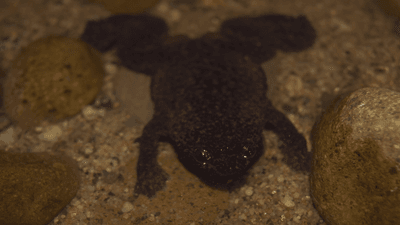


The only lungless frog in the world has been exposed as a fraud, in fact being the secret owner of a tiny pair of lungs and glottis – respiratory organs that had previously been declared as absent in the rare Bornean flat-headed frog. New research looked at museum specimens using a high-resolution micro-CT scanner and discovered that the previous conclusion that they were lungless frogs was, in fact, incorrect.
Lungless tetrapods – that is, animals on four legs like amphibians, reptiles, and mammals – are relatively rare, but include one caecilian and numerous salamanders. Instead of breathing with lungs they breathe through nonpulmonary tissues, like the skin and mucus membranes in their mouths and throats.
The Bornean flat-headed frog, Barbourula kalimantanensis, was believed to be a part of the lungless crew. Living in cold, oxygen-rich waters, scientists figured that it must be getting its full oxygen quota through its skin.
That was until a team of scientists embarked on a large-scale project to use micro CT scanning to look at the internal anatomy of various vertebrates. Using two specimens that had been pivotal in the initial “discovery” that Bornean flat-headed frogs were lungless, they realized that there was in fact a tiny set of lungs tucked inside their bodies.
“As in other frogs, the pulmonary apparatus of B. kalimantanensis contains a glottis that is located posterior to the tongue on the floor of the buccal cavity and just dorsal to the hyoid plate,” write the study authors. “The glottis is also visible in preserved specimens, and may have been overlooked because of the folds of the buccal floor. The presence of the laryngeal dilator muscles, which open the glottis during breathing in other frogs, suggests a typical functional respiratory system in B. kalimantanensis.”
That the lungs are so minute suggests that Bornean flat-headed frogs probably do also rely on skin breathing, but evidently, planet Earth is no longer a place that can claim to be home to a lungless frog. Having such small lungs may benefit these animals in making them less buoyant, as getting swept away in currents is a considerable threat in fast flowing waters. It may also influence how their vocalizations transmit in the water, as has been seen among other aquatic frogs.
The authors sign off their study expressing that we have the sharing of biological specimens from natural history collections to thank for the discovery, as without these, they’d never have been able to dive into the anatomy of the “world’s only lungless frog”. Now, who fancies a trip to the museum?
The study is published in Current Biology.