Nature
 PUBLISHED


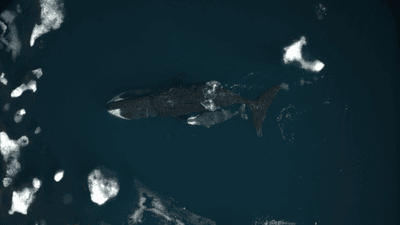


The record for longest gestation in a mammal – that is, how long it takes to cook up a baby – has a curious new contender, as a new study on bowhead whales has revealed their bloodwork indicates they could be pregnant for up to two years. However, whether this topples the African elephant for the longest gestation (at 22 months) is up for question, as it may be that the whales aren’t actually pregnant, but employing some physiological tactics for growing the best offspring at the best time.
Before we dive into the mysterious world of whale reproduction, it’s perhaps worth touching on why the length of pregnancy differs from the length of gestation.
“Gestation is the period of time between conception and birth - when an embryo/fetus develops within the uterus of a female mammal,” explained lead of the new study, Nadine Lysiak, to IFLScience. “In humans, the gestation length is 38 weeks.”
“In humans, gestation length is ~ 2 weeks less than pregnancy length because ovulation and conception occurs ~ 2 weeks into the menstrual cycle. In wild mammals, we focus on gestation period.”
One way in which you can measure gestation in wild animals is by looking at their bloodwork, as we know that certain hormones will be higher during gestation, such as progesterone. For bowhead whales (Balaena mysticetus), this has been difficult to establish as they spend very little time at the surface, but estimates have put their gestation period at around 14 months.
However, that’s been thrown out following research that monitored 10 female bowhead whales from the Canada-west Greenland population. Three of the group were immature and had routinely low progesterone levels, but the seven adults had high levels for a staggeringly long time.
“On its face, our findings show that bowhead whales have progesterone elevations for 23.5 months on average - beating the gestational period of elephants,” continued Lysiak. “It was really exciting to see the extended progesterone peaks in bowhead baleen - it was not what we expected.”
If this remarkable length of progesterone elevation is indeed indicative of the time spent growing bowhead calves, it would make for the longest known gestation of any mammal on Earth. However, there are some other possible explanations as to why the pregnancy hormones were so high for so long.
“In the paper we explore some evidence from field observations (from subsistence whaling) that suggest bowhead whales aren’t actually pregnant for ~ 2 years,” said Lysiak. “We explored a few hypotheses for how to define gestation when looking at baleen progesterone levels as well as reasons why progesterone might be elevated in baleen in advance of gestation. This includes estrous periods with elevated progesterone or delayed implantation.”
Progesterone wasn’t the only raised level in these whales, and some of the spikes in glucocorticoids including cortisol or corticosterone may be an indicator of stress rather than pregnancy. Furthermore, it’s possible that the raised progesterone is the result of females experiencing sequential ovulations.
As an adaptation, sequential ovulation could increase bowhead females’ fitness for Arctic conditions where the environment can be unpredictable. They’re a polyandrous species, meaning females mate with many males across a single breeding season, so releasing multiple eggs could give them options as to the “best” sperm to bring into the next generation.
More research is needed to clear up some of the unknowns about the sex lives of these solitary animals, but it’s a fascinating insight into how whales took the mammalian form and ran with it to make themselves the best fit for a marine environment.
The study is published in Royal Society Open Science.