Nature
 PUBLISHED


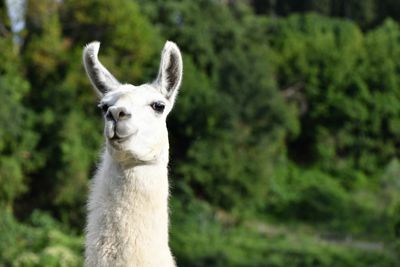


We’ve had just about as much as we can take of animals being deceptively, and sometimes deviously, smart this week. First, magpies demonstrated their lawlessness by building nests with material meant to deter them – now it turns out llamas, too, are sharper than you might imagine.
The canny camelids (not to be confused with alpacas) are capable of social learning – learning from others – something they’re especially good at after having observed humans. Researchers on a new study found that llamas' problem-solving abilities were much improved after watching humans, as well as other llamas, complete a task first – possibly a consequence of thousands of years of domestication.
Social learning has previously been identified in a number of species, ranging from primates to creepy crawlies. Usually, information is passed on from older and more experienced individuals in the same social group (and of the same species), but it can also be acquired from other species, including humans.
“Due to increasing human presence worldwide, humans are a part of many, if not most, species’ natural environments to date,” the study authors write. They can be treated as irrelevant or a threat, but for some species, particularly domesticated ones, there can be a lot to learn.
“It would be advantageous for domesticated animals to pay close attention to human behaviour as a source of information about the environment that allows to predict events, such as feeding times or locations,” the authors continue.
So far, research into social learning between humans and animals has focused largely on pets and companion animals, meaning other domesticated beasts, such as llamas (Lama glama) have been overlooked.
Looking to rectify that, and put llamas' smarts to the test, the team set 30 of them, from three German farms, the task of finding a food reward behind a V-shaped fence. Some were allowed to watch a human successfully locate the food, another group observed a trained llama complete the task, while a final group was let loose with no prior help.
Those that watched either a human or llama complete the task were more successful: only two that didn’t receive guidance found the food, compared to six that watched other llamas, and seven that watched humans.
Successful llamas didn’t always follow the same route as their demonstrator, instead adopting a more general detour behavior.
This ability to learn from humans may have developed as a result of domestication, suggesting that llamas may have become tuned in to human cues since they were domesticated from Guanacos (Lama guanicoe) around 3,800 to 5,000 years ago.
The study is published in Animal Cognition.