Nature
 PUBLISHED




Are you good at impressions? Could you pull off a decent Tom Hanks or the Australian twang of Margot Robbie? In the bird world, there are some seriously good mimics, and now a lyrebird in an Australian zoo has been recorded mimicking the sound of an object that is almost indistinguishable from the real thing.
At Adelaide Zoo, Australia, last year, visitor Stephanie Kothe filmed one of the zoo’s lyrebirds, named Nova, mimicking the sound of a Polaroid camera shutter complete with motor whir with near-perfect accuracy. It's quite uncanny.
Do you take requests?
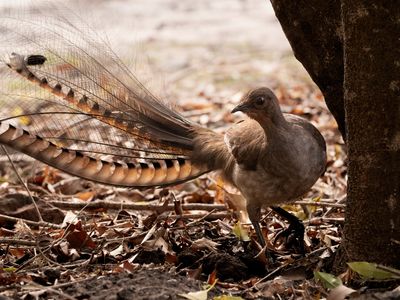
Superb lyrebirds (Menura novaehollandiae) are endemic to Australia and are known for their ability to mimic everyday sounds and even the calls of other species.
While these small brown birds have fabulous tail feathers, it's their song that gets them the attention. Around 80 percent of their song is made up of copied sounds from their environment; this can include the vocalizations of other animals or birds, chain saws, car alarms, and anything else they might have come across.
“Nova can mimic things like other birds around the zoo; he mimics magpies, rosellas (parrots), and rainbow lorikeets," Kiona, a bird keeper at Adelaide Zoo, told Peta Pixel.
"He also mimics some of the other birds inside the aviary, so the laughing kookaburra; he also mimics the blue-winged kookaburra. He can also mimic human-made noises, so things like chainsaws. He can mimic the sound of a radio button click."
Yes sir, I can boogie
As well as singing, the males sure can boogie.
The males have fabulous long tail feathers that, when displayed, resemble the shape of a lyre, from which the birds get their name. Young males and females also have long tail feathers but lack the specific feathers to make the lyre shape.
To attract a mate, the male will shake his tail feathers over his head while singing, hoping to woo a female. Males can breed with more than one female in a season while the females incubate, hatch the eggs, and rear any offspring alone.
Other excellent mimics
Other species have also mastered certain aspects of sound mimicry. For example, orcas have mimicked human language, including words like "hello" and the name of a trainer, "Amy".
An aquarium seal named Hoover even mastered some English in the 1970s. And who could forget the world's first talking duck, Ripper (an IFLScience favorite), and his impression of his owner's colorful language.
In slightly more unsettling news, EMO the robot has learnt to mimic human lip movements by watching YouTube. We’ll forgive you if this doesn't make your favourites list.