Humans
 PUBLISHED




There have been plenty of unusual crimes over the years, and serial killers that turn out not to have existed at all, for instance. But few crime stories are as unusual as the Lindow Woman, in which a 1,600-year-old bog body led to the successful conviction of a man for murdering his 20th century wife.
In 1959, portrait artist and travel enthusiast Malika de Fernandez, quite unfortunately, met Peter Reyn-Bardt, an airline employee, and entered a short whirlwind relationship. Two hours after meeting, Reyn-Bardt asked Fernandez to marry him, and two days after that they were married.
The relationship did not last long. A few months later, Fernandez began to travel the world again, now getting a great deal using her husband's employee discount, whilst Reyn-Bardt remained at his cottage in Cheshire, England.
Two years later, nobody could find Fernandez at all, and naturally Reyn-Bardt became suspect number one in her disappearance. The police conducted thorough searches of his property, and even dug up the garden in search of remains, but were unable to find any evidence that she had been killed or disposed of there, nor any signs of any wrongdoing on the part of Reyn-Bardt.
Yet Fernandez did not show up, and the case remained unsolved for decades, before events took an odd twist, in the shape of body parts being found in peat bog near Reyn-Bardt's home.
At this point, Reyn-Bardt's embarrassing lack of knowledge of peat bogs came back to bite him, and ended with his conviction for his wife's murder.
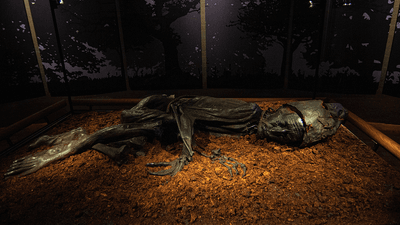
Peat is created through the decomposition of organic matter, largely from plant materials such as moss. When Sphagnum moss, in particular, accumulates in wetlands enough to form a bog, the layers of peat form acids that are incredibly good at preserving bodies.
Fall into one of these – or get murdered or sacrificed and thrown into one of these – and when you get discovered centuries later, you very well could look like somebody who fell in yesterday while playing dress-up as a murdered 400 BCE peasant.
If Reyn-Bardt had known this, he might not have been so quick to confess to killing his wife.
After the head of an unknown woman was found in the Lindow Moss peat bog, forensics initially believed it to be 30-50 years old, given the astonishing preservation that had taken place. The police confronted Reyn-Bardt with the evidence, assuming it to be related to the disappearance of Fernandez a few decades prior.
“It has been so long, I thought I would never be found out,” Reyn-Bardt reportedly told the police during questioning. In his confession, he claimed that Fernandez had returned to his cottage sometime in the early 60s and threatened to reveal that he was gay – which was still criminalized in England at the time – if he didn't give her money. Without any money, he said, they fought.
“Something just boiled over inside me,” he added, later telling the court that he had grabbed her and begun shaking her, and didn't realize he had killed her until he stopped. “I was terrified and could not think clearly. The only thing that came to mind was to hide her."
Reyn-Bardt said that he dismembered her body with an ax, before attempting to burn her. When this didn't work, he took her to the nearby bog and threw her body inside.
The case, unsolved for 20 years, now seemed open and shut. You don't generally continue investigating when you have a body, and a previous suspect who has now confessed to the murder.
But the lead investigator, Detective Inspector George Abbott, was bothered by the lack of other body parts found near the head. He sent off the skull for further analysis at Oxford University, at which point they discovered through carbon dating that the skull dated back to the Roman era, and the remains are now known simply as the "Lindow Woman".
"The skull had been preserved in the peat bog for over 16 centuries and obviously has nothing to do with Malika Reyn-Bardt," prosecutor Martin Thomas told the court. "But the supreme irony is this: its discovery led directly to the arrest of the defendant and to his detailed confession."
When Reyn-Bardt learned of this development, he attempted to withdraw his confession, but it was what's known in the legal profession as "a bit late for takesies backsies". It took the jury three hours to find him guilty of murder, and he remained in prison for the rest of his life.
Fernandez's body remains undiscovered to this day, but another body – known pretty uncreatively as the Lindow Man – was found in 1984 during peat collection. Though nobody was arrested for his death, which likely occurred 2,000 years in the past, it is thought that the man had his throat slit before he was placed face down into the bog.
There's also evidence that suggests the Lindow Man may have been part of a ritual sacrifice, including mistletoe pollen in his stomach – used in druidic rituals – and a surplus of copper pigment on his torso, which could be part of a ritual surrounding his death. Nobody, as yet, has come forward to confess to his murder.
An earlier version of this article was published in April 2021.