Space and Physics
 PUBLISHED


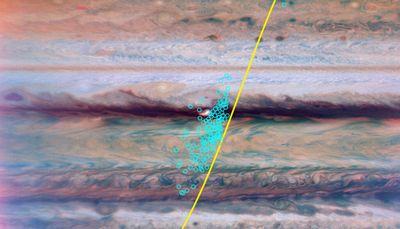


The ancient Greeks will never know how right they were in naming the planet Jupiter after Zeus himself. New observations reveal that lightning bolts on the king of the planets are more than 100 times more powerful than their earthly counterparts – maybe stronger.
The detailed observations of bolts on Jupiter are providing new insights into the atmospheric behavior of the planet, beyond its giant storms. They are also opening the door to new mysteries, because the power was surprising
Jupiter is very active storm-wise, and this means that it is usually difficult to pinpoint the sources of bolts. During 2021 and 2022, there was a lull in storms in the North Equatorial Belt; researchers were able to focus the Hubble Space Telescope and amateur telescopes on the region investigated by NASA’s Juno probe, which has been studying the Jovian atmosphere among other things since 2016.
Juno doesn’t see the lightning directly, but measures the microwave pulses emitted by the electrical discharge. By knowing the location of a storm, it was possible to measure the power of the lightning bolts compared to Earth. The emission of lightning is a window into the behavior of the atmosphere.
“[Jovian lightning] tells us about convection, which is how the atmosphere churns and transports heat from below,” lead author Michael Wong, a planetary scientist at UC Berkeley’s Space Sciences Laboratory, said in a statement. “Convection operates a little bit differently on Earth and Jupiter because Jupiter has a hydrogen-dominated atmosphere, so moist air is heavier and harder to bring upward.”
Wong stresses that there are uncertainties on the actual power value. Lightning measured on Earth is estimated using different radio wavelengths, so the actual value might be different. And not just smaller – some bolts could be between 500 and 10,000 times more powerful.
Such power means a higher voltage between the storm clouds of Jupiter. The storms are indeed 10 times as tall on Jupiter compared to Earth, but it's not clear how the power of the bolts scales. This might be due to differences in the chemical composition of those clouds or the whole atmosphere.
“This is where the details start to get exciting, where you can ask, ‘Could the key difference be hydrogen versus nitrogen atmospheres, or could it be that the storms are taller on Jupiter and so there’s greater distances involved?’” Wong added.
“Or could it be that greater energy is available because with moist convection on Jupiter, you have a bigger buildup of heat needed before you can generate the storm to create lightning?” he added. “It’s an active area of research.”
The study is published in the journal AGU Advances.