Space and Physics
 PUBLISHED



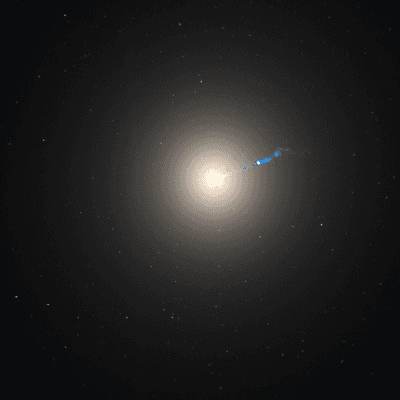


Galaxies are broadly divided into three groups. You have the spirals like the Milky Way and Andromeda, the irregular galaxies, and the elliptical galaxies. This latter group tends to have the most massive and usually most aged population of stars. The idea is that these elliptical galaxies arrive at their final shape through collisions across the ages of the universe. This is what will happen to Andromeda and the Milky Way when they merge in several billion years. But new observations suggest that maybe some elliptical galaxies have been spherical from the time of the ancient universe.
Researchers looked at galaxies during cosmic noon, the period when the universe experienced its peak of total star formation – that is, between 10 and 11 billion years ago. The team used the Atacama Large Millimeter/submillimeter Array (ALMA) to study the 100 brightest galaxies visible in submillimeter light. They were forming stars when the cosmos was between 1.6 and 5.9 billion years old, from just before to just after cosmic noon.
These objects are so bright because they are forming a lot of stars. They are undergoing a starburst episode (or multiple ones in rapid succession). They are big and bright and the perfect ancestors for the massive elliptical galaxies that we see in the local universe. While in the local universe most of the star formation comes from spiral and irregular galaxies, the team found this was not the case back then.
Most of these Submillimeter Bright Galaxies (SMGs) are not disk-like – they are compact spherical objects. The team used new statistical analysis techniques to determine how their three-dimensional stellar distribution is likely to be based on their light, which they found by measuring the potential axis lengths of these objects. Disks should have one axis much shorter than the other, while elliptical galaxies are truly egg-shaped. Most of the galaxies in the sample were like that.
So it looks like the biggest galaxies in the modern universe were already spherical a long time ago. Their intense starburst phase is a symptom of what made them spherical. The accreting of cold intergalactic gas and their interactions with other galaxies are both expected to have played a role in shaping these objects, according to the team's models.
The team wants to know more. With current observatories such as Euclid and JWST, as well as the upcoming China Space Station Telescope (CSST), researchers hope to map the stellar distribution of these galaxies better. That will provide a clearer idea of exactly how the likely ancestors of the supergiant elliptical galaxies came to be.
The study is published in the journal Nature.