Nature
 PUBLISHED


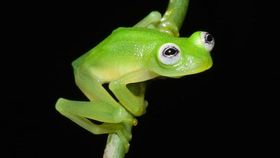


The discovery of a new type of frog has finally revealed the exact species of the world's most beloved amphibian. Besides the striking family resemblance, Hyalinobatrachium dianae also stands out for having skin on its underside so translucent that its organs are visible.
H. dianae's discovery was announced in Zootaxa by Brian Kubicki, founder of the Costa Rican Amphibian Research Center, who disappointingly chose to honor his mother, Janet Diana Kubicki, rather than Jim Henson with the name. This decision is somewhat reedemed by its popular moniker: Diane's Bare-Hearted Glassfrog.
Credit: Brian Kubicki. Green above, clear-skinned below.
Despite misinformation spread by chat shows, the frog's native habitat is the mid-altitude rainforests of eastern Costa Rica, not swamps.
Kubicki attributes the failure to discover such a brightly colored frog before now to its strange mating call, which he told The Tico Times has a metallic sound more likely to be associated with an insect than an amphibian.
Like other Hyalinobatrachium, H. dianae is a glassfrog, one of over a hundred species to feature the translucent skin, whose evolutionary benefit remains unexplained. Central America in general, and Costa Rica in particular, is a hot spot for these creatures. Based on genetic analysis, the discoverers describe the closest relative as H. chirripoi, which while showing some family resemblance is never likely to be confused with the famous muppet.
Kubicki and his colleagues found just six specimens, too few to assess the range of the new species or whether it is endangered. However, one commentator on the Tico Times website said, “This was amazing to read. I had this frog on my leg when repelling waterfalls in the mountains above Tres Rios, Coronado [west of the habitat the biologists identified] just 2 weeks ago. None of us had ever seen it before and our frog did not want to leave us. It just enjoyed hanging on and staying with us.” Sure sounds like Kermit to us.
H/T: Mashable