Space and Physics


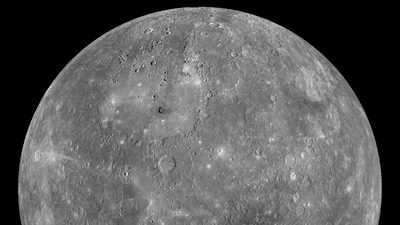


Despite struggling to determine the atmospheres of rocky planets orbiting nearby stars, the JWST appears to have achieved what would seem a much harder goal: finding what the surface of one of those planets, Kua’kua, is made of. This staggering development could signal a major advance in our capacity to learn about worlds lit by stars other than our own, and eventually find those most similar to Earth.
Originally known as LHS 3844b, Kua’kua is around 30 percent bigger than Earth, and orbits a red dwarf 48.5 light-years from us. It orbits so close that from the surface LHS 3844, taking just 11 hours to go around, that its star would take up almost 10 degrees of the sky. Even allowing for how cool LHS 3844 is, emitting 400 times less light than the Sun, a planet that close is inevitably extremely hot.
Consequently, astronomers have never considered Kua’kua habitable, and expected that any atmosphere it might have been formed with would long since have been blasted away. However, they reasoned if current or recent volcanic activity was occurring, it might have created an atmosphere that had yet to escape.
Kua’kua was the first rocky planet confirmed to be tidally locked, so that one side always faces LHS 3844 and gets hot enough to produce a lot of infrared radiation. When nearly behind LHS 3844, the star-side of the planet is pointed towards us, and adds to the radiation from the star itself.
The two sources are too close to distinguish, and In the visible light, that addition is insignificant. However, in the mid-infrared Kua’kua makes a small, but not tiny, addition to the radiation we receive. A comparison of the radiation received when Kua’kua has its hot and cold sides pointed towards us theoretically offers an opportunity to work out the exact frequencies at which the radiation is brightest, offering clues about composition.
When JWST turned its attention to Kua’kua, its Mid-Infrared Instrument (MIRI) detected no hint of gases, suggesting volcanic activity most likely stopped a fair while ago. That matches previous observations, although it contradicts one previous paper.
However, besides finding yet another hot, airless world, MIRI’s spectrum combined with data from TESS and the Spitzer telescope revealed a planet whose surface appears to be basalt, or something similar. Although basalt is a familiar component of Earth, more silicate-rich rocks like granite make up most of our planet’s crust, but we don’t see much sign of them in Kua’kua’s spectrum.
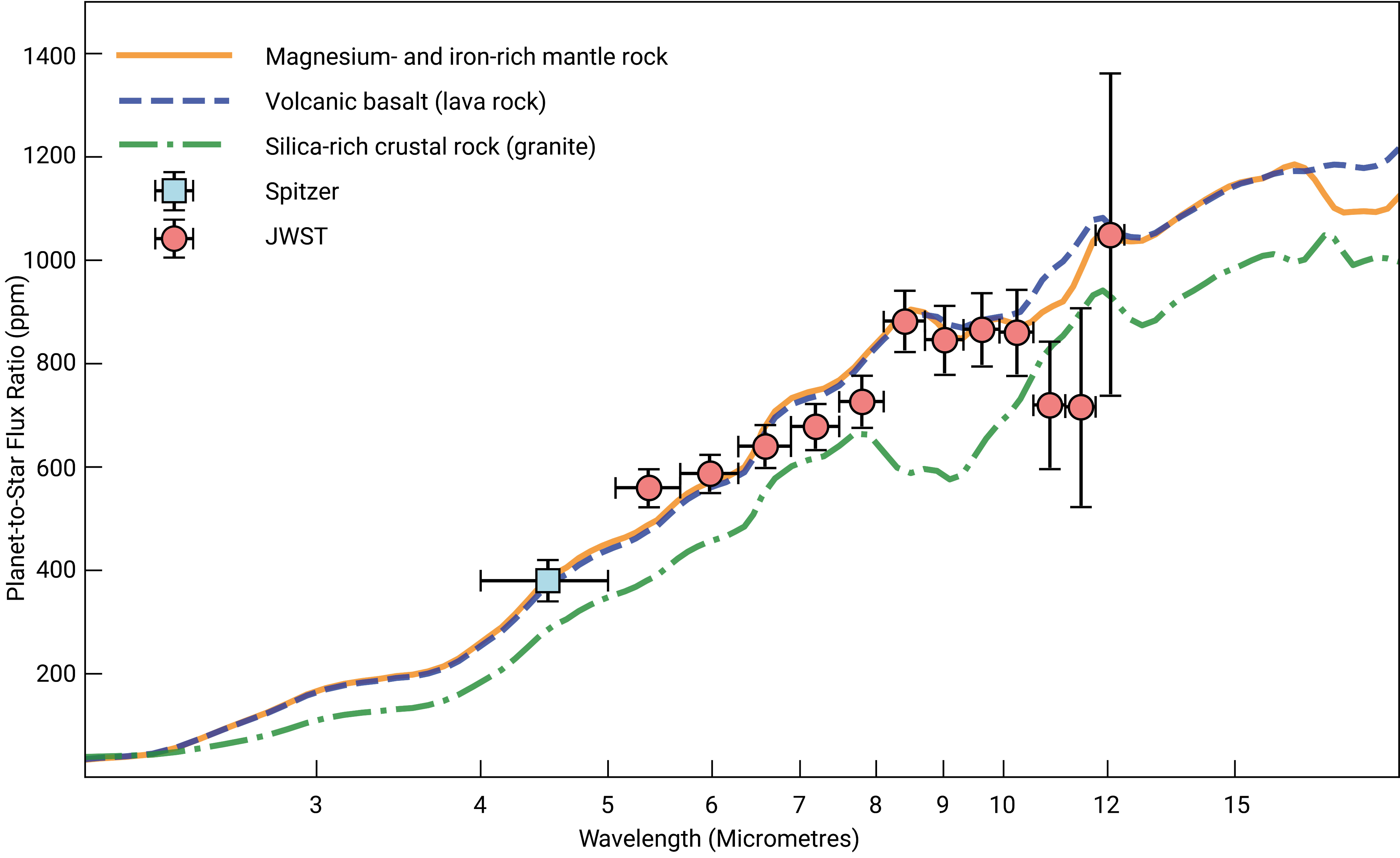
Given that the Moon, Mercury, Venus and Mars are all predominantly basalt, Kua’kua’s surface composition just adds to evidence that Earth is the exception in this regard. Whether that’s essential for our planet’s status as the inhabited world remains unknown. However, it’s unlikely to be a complete coincidence. Our abundance of silicon rich surface rocks are thought to be a product of plate tectonics, which in turn may have been made possible by Earth’s abundance of liquid water acting as a lubricant.
“Since LHS 3844 b lacks such a silicate crust, one may conclude that Earth-like plate tectonics does not apply to this planet, or it is ineffective,” Sebastian Zieba of the Harvard and Smithsonian Center for Astrophysics said in a statement. “This planet likely only contains little water.”
Extraordinary as such a discovery would be at this distance, Zieba and colleagues do not stop there. They argue the sensitivity of the spectrum the JWST collected is sufficient to indicate considerable magnesium and iron.
The other thing the authors are keen to learn is Kua’kua’s surface’s age.
A planet without an atmosphere will suffer frequent micrometeorite bombardment, and so close to its star would also be bombarded by high energy radiation. “It turns out, these processes not only slowly dissolve hard rocks into regolith, a layer of fine grains or powder as found on the Moon,” explains Zieba.
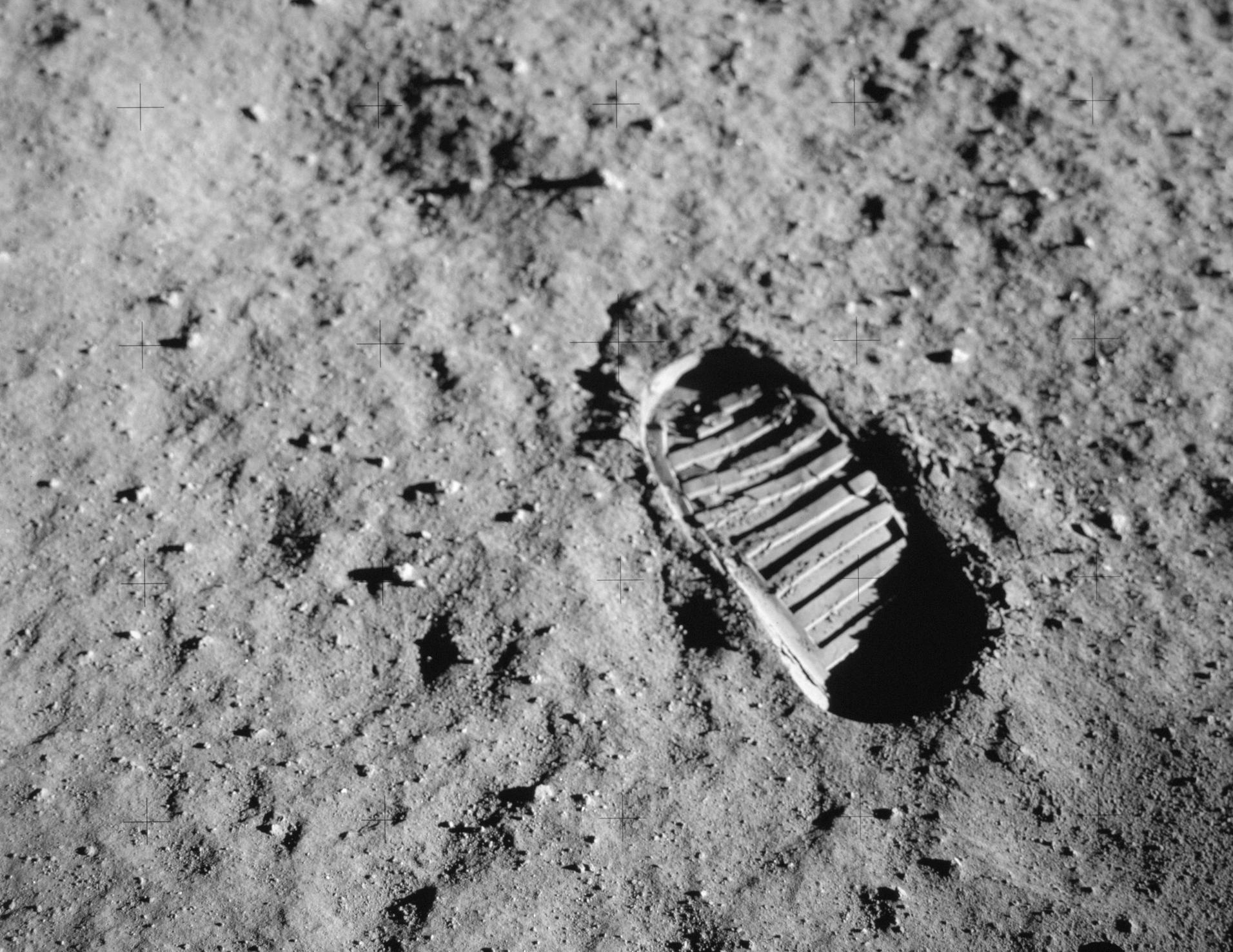
The authors have two models of LHS 3844b’s geologic development. In one, widespread volcanic activity was relatively recent, producing a dark surface of basaltic or magmatic rocks that have not yet had the time to be greatly broken down. The second model looks more like the Moon, with deeply weathered surfaces that would be covered with dust like those in which the Apollo astronauts left their footprints.
Zieba noted that while simply pulverizing basalt makes it lighter, micrometeorites “also darken the layer by adding iron and carbon, making the regolith’s properties more consistent with the observations.” The JWST observations are darker than might be predicted if the basalt had been turned to a fine powder, but not yet darkened by extended space weathering, so a middle-aged surface is unlikely.
For the moment, the team favor the older surface model. However, further observations will track how LHS 3844b’s appearance changes with viewing angles, which provides an indication of surface roughness, potentially settling the debate. “We are confident the same technique will allow us to clarify the nature of LHS 3844 b’s crust and, in the future, other rocky exoplanets,” said Dr Laura Kreidberg of the Max Planck Institute for Astronomy.
Although the work expands our sample of rocky planets whose geology we can explore, we’re still a long way from being able to do the same with cooler planets, where liquid water may be present. Even among other hot planets studied by the JWST, Kua’kua has the highest signal to noise ratio.
The name Kua’kua comes from an Indigenous Costa Rican word for butterfly.
The study is published in Nature Astronomy.