Space and Physics
 PUBLISHED
 22
22


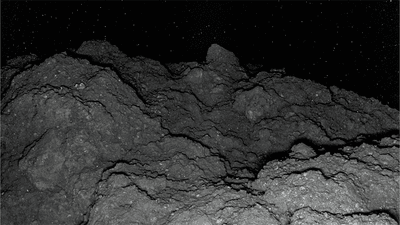


Japan's Hayabusa2 spacecraft is heading towards its final target; a small, rapidly rotating asteroid, believed to be around the size of a spacecraft. According to a new and intriguing paper (though not necessarily with correct conclusions) there may be a very good reason for that, with the headline being that it may be of technological origin.
Hayabusa2, the Japanese space agency's (JAXA's) asteroid sample collecting spacecraft has already been on one hell of a journey, collecting samples of material from asteroid Ryugu, before dropping off those samples during a flyby of Earth. In 2020, shortly before those samples were returned to us, JAXA announced a new target for the spacecraft, and a long extension to the mission.
"The destination will be the small asteroid 1998 KY26. This is a long-term mission that exceeds 10 years and, after an itinerary of various events, we aim to rendezvous with the rapidly rotating 1998 KY26," JAXA said. "We may also attempt particular challenges, such as dropping a target marker or touchdown."
That task, it turns out, is more difficult than initially anticipated. In 2024, a team of astronomers used the Very Large Telescope at the European Southern Observatory, expecting to confirm previous estimates of the object's size and mass, but found that it may be a very tricky object to land on.
“We're surprised to discover that the object looks completely different from what was expected; it was much smaller, three/four times smaller than expected. It's spinning faster, twice as fast. And also the composition itself… It's much brighter," lead author Dr Toni Santana-Ros, a planetary scientist at the University of Alicante and University of Barcelona, explained to IFLScience.
"The funny thing is that the object is about 11 meters in diameter, and the spacecraft itself is 6 meters [20 feet]. So it's more than half of the object it’s going to visit. It's quite a funny thing!”
"1998 KY26 may be of technogenic origin"
According to a new preprint paper that is yet to be peer-reviewed, JAXA may be in for one more surprise as they approach the object when it approaches it in July 2031. Looking at the object's path and comparing it to potential paths of an old Soviet-era spacecraft that failed en route to study Mars's "doomed moon" Phobos, the team suggests that humans may have gotten pretty close to the object when we assembled it.
Launched on July 7, 1988, Phobos 1 operated normally for a few months, before falling out of contact with Earth on September 2, 1988, the result of an incorrect sequence sent to the spacecraft – a single hyphen out of place. That mistake may have unintended consequences decades down the line, with the new paper suggesting that the asteroid targeted by JAXA may actually be another spacecraft, setting the scene for the Spider-Man points at Spider-Man meme in space.
"Our new paper shows that two propulsive velocity thrusts (∆Vs) combined at 1.9 kilometers per second, the first just after loss of mission and the second in May 1996, allow the orbits and phases of the two bodies to align, with an arbitrarily low separation in velocity-position space," astronomer Avi Loeb explains in a blog post. "There is also evidence that 1.9 kilometers per second was within the performance envelope of Phobos 1, which had a powerful nitric acid and amine-based autonomous thruster for Mars Orbital Insertion."
While the team points out that their work is far from conclusive, there may be a few reasons to take the hypothesis seriously, at least, including evidence that the spacecraft delivered some thrust shortly after the mission was unexpectedly cut short.
According to the team, the spacecraft idea could explain the object's high reflectivity, as well as why it has kept itself together despite its fast spin, behavior not expected of a rubble pile asteroid (though a more solid structure, or factors we have yet to discover, could also explain this, too). The team adds that the object appears to be "quite elongated", given the changes in its brightness as seen by humanity's telescopes.
It's a fun idea, and it would be quite something to see in 2031. If it turned out to be correct, it would be the first time humanity has accidentally attempted to land on the surface of a second, equally-sized spacecraft, for example. But for now, the work is an interesting "what if" rather than a solid conclusion, or probable scenario.
"In anticipation of the Hayabusa2 observations in 2031, which will be decisive in resolving the origin of this object, we encourage further observational, dynamical, and theoretical studies aimed at more tightly constraining the nature and properties of 1998 KY26," the team concludes.
The study is posted on the Center for Astrophysics | Harvard & Smithsonian website.