Space and Physics
 PUBLISHED
 1
1


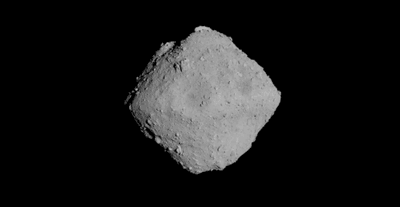


The formation of life on Earth is one of the big questions of science that remains without a certain answer. It is possible that our planet already had all the ingredients and just needed the right conditions. It is also possible that the ingredients were delivered from space. We have found ample evidence of crucial molecules in meteorites and asteroids, and new research has just added a bit more.
A team of Japanese scientists has confirmed that all five nucleobases – the building blocks of DNA and RNA – are present in the sample that the Japan Aerospace Exploration Agency’s Hayabusa2 mission collected on Ryugu. DNA has four bases: adenine, guanine, cytosine, and thymine; in RNA, thymine is replaced with uracil.
Hayabusa2 brought back to Earth 5.4 grams of material from Ryugu. In this study, two samples of the material, around 10 milligrams each, were used. One was from the surface, the other from the subsurface after the spacecraft shot a cannonball at the asteroid. In both samples, the team found the five nucleobases, and in roughly the same quantities.
The team also believes that observations show that these five nucleobases formed with a shared pathway – and not just on Ryugu. A similar chemical richness has been discovered on asteroid Bennu, which was visited and sampled by the NASA mission OSIRIS-REx, although there was a preference for the pyrimidines: cytosine, thymine, and uracil. This is what was also seen in the meteorite Orgueil that fell in France in 1864.
The Murchinson meteorite that fell in Australia in 1969 was instead enriched in purines, adenine and guanine. Ryugu, with its balanced mixture, sits in the middle. It is believed that both Bennu and Ryugu come from the same water-rich parent body, where a lot of chemistry took place. These differences in the fine details might be due to ammonia, as this molecule can affect which nucleobases form.
The details of exactly how these molecules formed in space and under what precise conditions remain uncertain. What is undeniable, though, is that each analysis of both Ryugu and Bennu shows a vast richness of organic molecules, and in particular those molecules that we believe are fundamental for life. We do not know if asteroids are responsible for spreading those crucial molecules to Earth or not. Regardless, the fact that asteroids are loaded with them suggests that the conditions for the molecules would not have been rare.
The study is published in the journal Nature Astronomy.