Space and Physics
 PUBLISHED



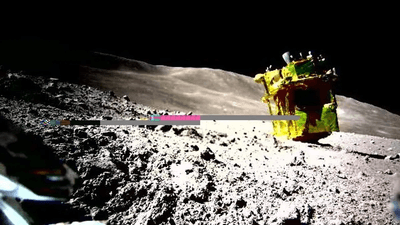


It’s been a few days of good news for lunar exploration. First, Intuitive Machine's Odysseus became the first US lander in over 50 years, and the first private one, to land on the Moon – even if it did land a little wonky, as is the trend. Now, the Japanese Space Agency (JAXA) reports that its own SLIM lander has managed to survive the extremely cold and unforgiving lunar night.
Both SLIM and Odysseus landed on their sides, a reminder of how difficult it still is to land on the Moon, even if everything else goes well. The situation caused SLIM some major problems. When it landed on the lunar surface on January 19, its awkward position prevented its solar panels from powering up and left the lander running on batteries. JAXA hoped that as the Moon moved around the Earth, the Sun’s rays would hit the lander just right, kickstarting the mission into gear – which luckily it did.
However, this meant the mission had even fewer days of sunlight to work with than originally expected before the lunar night, which is not merciful, set in. During the day, temperatures on the Moon can reach 121°C (250°F) but at night they drop down to -133°C (-208°F). Coupled with the fact it lasts 14 days, the lunar night has seen the death of many robotic missions, including the recent Indian lander Vikram and its rover.
There was no guarantee that SLIM would wake up once lunar day rolled back around but JAXA has announced that it sent a message to the lunar and got a reply back.
“Last night, a command was sent to #SLIM and a response received, confirming that the spacecraft has made it through the lunar night and maintained communication capabilities!" JAXA said in a series of tweets.
But the sturdy lander has the opposite problem now. It’s lunar midday there, and it could easily overheat if it starts working.
"Communication with #SLIM was terminated after a short time, as it was still lunar midday and the temperature of the communication equipment was very high. Preparations are being made to resume operations when instrument temperatures have sufficiently cooled,” JAXA wrote.
SLIM has more than exceeded the expectations for the mission. The goal was a precision pinpoint soft landing within 100 meters (330 feet) of a specific target area. SLIM appears to have landed just 55 meters (180 feet) from its target, a precision never achieved before on another world. As a comparison, the expected landing site for Apollo 11 was an ellipse 20 kilometers by 5 kilometers (12 by 3.1 miles).