Humans
 PUBLISHED
 1
1


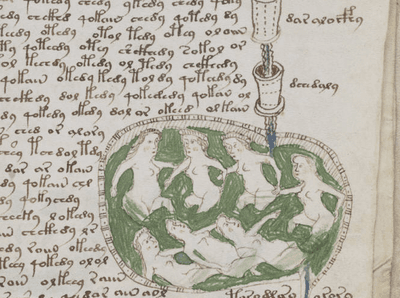


New research is helping to demystify the Voynich Manuscript, long hailed as “the most mysterious manuscript in the world.” While the puzzle remains uncracked, some clever scientific sleuthing indicates that the unintelligible text could have been created using a cipher. If true, it means the bizarre book could potentially be deciphered.
The Voynich Manuscript is a book-like text from the early 15th century written in an unknown script, accompanied by a bunch of puzzling doodles of people, animals (including a dragon), plants, castles, and astrological symbols.
The whole thing can be viewed here on behalf of Yale University's Beinecke Rare Book and Manuscript Library.
No one knows who wrote it, what it says, or why it exists. Some have argued the script is mere gibberish, while others believe it represents an unknown language of its own. Another common theory is that it was crafted using a cipher, a cryptographic system designed to scramble text using an algorithm. As it stands, we just don’t know.
Steeped in mystery, it’s attracted a huge amount of interest over the centuries. One person who has fallen under its powerful spell is science journalist Michael Greshko, who has just published a peer-reviewed study on the topic.
Speaking to IFLScience, Greshko says his project started humbly as a cure for the monotony of COVID-19 lockdowns.
“I would sometimes sit and flip through a facsimile copy of the Voynich Manuscript, just to soak in that wonder and mystery. Somehow, that led me to start messing around in Microsoft Excel to come up with a cipher that could mimic ‘Voynichese,’ the peculiar text of the Voynich Manuscript. The goal was never to publish a paper; it was simply to give myself a satisfying, and distracting, mathematical puzzle,” Greshko explained.
To explore this idea, he developed what he calls the Naibbe cipher, an algorithm that takes a Latin or Italian text, strips it down to an unbroken string of letters, and then scrambles the rhythm by randomly respacing it into a mix of one-letter and two-letter chunks.
In this system, every one-letter chunk becomes a full Voynichese “word.” Two-letter chunks become “words” too, but with a twist: the first letter turns into a Voynichese “prefix,” while the second becomes a “suffix.”
An in-depth explanation of the Naibbe cipher can be viewed in the video above, around the 1 hour 32 minutes mark.
The long and short of it: the Naibbe cipher can generate text with striking similarities to the Voynich Manuscript.
This is especially remarkable given that the manuscript’s script displays unusual statistical patterns that have baffled researchers. Greshko asserts that this does not necessarily mean the Voynich Manuscript is a ciphertext, but it does show that such a system could generate something very similar, and that’s an idea worth exploring.
Crucially, however, the study does not mean that it’s “case closed” for the mystery of the Voynich Manuscript. The new study could provide other researchers with sharper tools to keep digging, but this enigmatic book remains as elusive as ever.
“It’s hard to even speculate on the nature of the Voynich Manuscript because – to my endless fascination and frustration – it holds up a mirror to whatever idea you have for it. If you think it’s gibberish, there’s plenty of evidence you can point to. Ditto if you think it’s an encoded message or even a language all its own,” concluded Greshko.
“The inherent ambiguity of the Voynich Manuscript is what makes it so mysterious – and so interesting.”
The new study is published in the journal Cryptologia.