Humans
 PUBLISHED


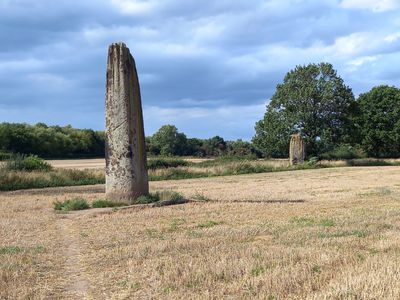


Prehistoric builders were fussy but determined, the kind of people who'd send a modern project manager into early retirement. Not content with a nearby deposit of perfectly good rock, it appears the makers of the Devil's Arrows decided to haul 25-tonne stone pillars over 18 kilometers (11 miles) across northern England to construct a megalithic monument.
What are the Devil's Arrows?
The Devil's Arrows are a set of vertical stones running from 179 meters (587 feet) along a north-northwest/south-southeast axis near the town of Boroughbridge in North Yorkshire, England.
Three stones still stand today, unevenly spaced and shrinking in size from south to north. The southern stone stands 6.9 meters (23 feet) high, the central one 6.7 meters (22 feet), and the northern one 5.5 meters (18 feet).
A fourth stone is believed to have once existed, just a few meters from the central stone, although it disappeared before modern records began.
Local legend says they are the work of the devil, who stood on Howe Hill and hurled them at a nearby town like spears. In reality, however, they were plonked there around 4,000 years ago, where they likely served as a meeting point for some ritualistic ceremony.
Based on their appearance, researchers have previously assumed the stones were sourced from Plumpton Rocks, around 13 kilometers (8 miles) away. While still a considerable distance, it appears the ancient builders decided to conveniently ignore this option and literally go the extra mile.
_Mid_00821840_001.jpg "A doodle of how the Devil's Arrow might once have appeared, drawn in 1778.")
New research shows an unexpected origin
Archaeologists and geologists at Curtin University and the University of York have recently analyzed the surface grains within the Devil's Arrows and found they are directly linked to a further deposit of rocks, Brimham Rocks, around 18 kilometers (11 miles) away.
“Our research shows these stones weren’t simply taken from the nearest available source – they were deliberately chosen from a challenging landscape 18 kilometres away,” Dr Anthony Clarke, lead study author from Curtin University’s Timescales of Mineral Systems Group within Curtin’s School of Earth and Planetary Sciences, said in a statement.
“Each stone weighs more than 25 tonnes, so moving them would have required incredible planning, coordination and engineering skill,” he added.
Why did they source the stone from far away?
What was it with prehistoric builders and their ridiculously lengthy supply chains? Stonehenge, located in southern England, has an equally baffling origin story in which its central Altar Stone came from 700 kilometers (434 miles) away in northeast Scotland.
Efficiency and convenience were clearly not the priorities of the day. Instead, it seems these communities sourced stones from much further than they strictly needed to, whether for aesthetic or quality reasons, or for something deeper.
“These results show that ancient communities were making deliberate and meaningful choices about where their stones came from,” Dr Jim Leary, study co-author from the University of York.
“It highlights the importance of landscape and shared belief systems, as well as the remarkable effort involved in transporting and raising stones of this size,” he added.
To find out more, the team hopes to carry out excavations at both the Devil's Arrows and its source site at Brimham Rocks to unravel their relationship.
“These next steps could help us better understand when the stones were moved and how these extraordinary monuments were constructed,” Dr Clarke said.
The study is published in Proceedings of the Royal Society A: Mathematical, Physical and Engineering Sciences.