Humans
 PUBLISHED



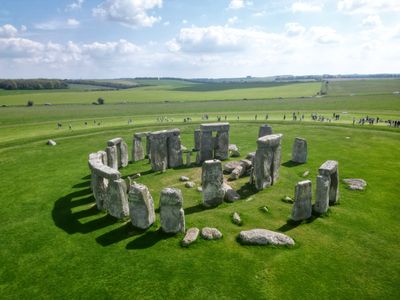


Stonehenge stands in southern England, but its central Altar Stone, a six-tonne hunk of sandstone, is believed to have originated in northeast Scotland, some 700 kilometres (434 miles) away. Since moving trucks and machinery were in short supply 4,000 years ago, how it got there is a bit of a mystery. A new study is a few steps closer to finding out.
In 2024, a team of earth scientists discovered Stonehenge’s Altar Stone wasn’t quarried from the local geology, nor from the Preseli Hills in southwest Wales, where some of the smaller bluestones originated. Their chemical analysis of the rock revealed striking similarities to the Old Red Sandstone of the Orcadian Basin in northeast Scotland at the very top of the British Isles.
The team explored the possibility that the rock was moved southwards across Britain by glaciers, which move across the landscape like a super-viscous syrup. However, by their workings, this didn't make sense. They found that almost all glaciers over the past 1 million years have gone northwards, the opposite direction to the rock’s movement.
Now, another team from Curtin University in Australia has taken a look at the conundrum. Using mineral grain dating and ice-sheet modeling, they agree that glaciers couldn’t have been the sole mechanism for the stone’s full journey. However, their models suggest that glacial movement might have helped move rocks from Scotland to Doggerland, a now-submerged patch of long-lost land that once sat to the east of present-day England.
That would have shortened the journey by roughly 300 kilometers (186 miles), but it still leaves 400 kilometers (248 miles) unexplained. Only humans, the team says, could account for the rest.
“Our modelling shows glaciers may have transported rocks part of the way during the last Ice Age — potentially as far as Dogger Bank in the North Sea — but not into southern England, meaning the stone would still have needed to be moved hundreds of kilometres by people,” Anthony Clarke at Curtin University said in statement.
“Rather than being carried naturally by ice, the evidence points to a deliberate, carefully planned movement across a challenging and varied landscape,” he continued.
What makes this feat all the more remarkable is that there is no evidence of any centralized, organized authority in Britain at the time, let alone maps and machinery. This would have been a meticulous, multi-stage operation, parts of which potentially used rivers and coastlines for water transport, but much of it would have had to have been done overland.
"Transporting a stone of this size over such a long distance would have required planning, coordination and a deep understanding of the landscape—not to mention tremendous determination," Clarke said.
“This suggests the stone was likely moved in stages, potentially combining overland hauling with river or coastal transport where possible."
To complete the picture, the researchers hope to pinpoint the Altar Stone's precise geological origin in northeast Scotland and investigate the exact role glaciers played in its lengthy journey south.
The puzzle of Stonehenge echoes other great mysteries of the ancient world. The big one, of course, is the Great Pyramids of Egypt, another awe-inspiring feat of construction that required the mass movement of very heavy rocks. We still don't fully understand how these structures were built, with theories ranging from wooden sledges and ramps to lost waterways, but none have yet proven fully satisfactory.
The new study is published in the Journal of Quaternary Science.