


 Space and Physics
 PUBLISHED


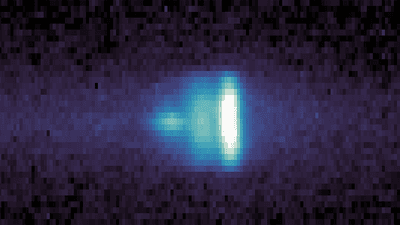


A new study looking at the isotopic ratios in interstellar comet 3I/ATLAS after its closest approach to our star has suggested it may have formed around an old, low-metallicity star in the Milky Way's outer disk.
If you don't know of our interstellar visitor by now, here is a brief recap. On July 1 last year, the Asteroid Terrestrial-impact Last Alert System detected an object racing through our Solar System on a path that would eventually take it right back out again. It was soon determined that the object, dubbed 3I/ATLAS, was an interstellar comet, briefly passing through our neck of the cosmos.
Since then, astronomers have been using this brief window of opportunity to study 3I/ATLAS. On that front, we don't have much longer now. The object has recently had its closest encounter with Jupiter, passing the planet at a distance of 0.35832 astronomical units (AU) – with one AU being the average Earth to Sun distance – and will now begin its long departure from our Solar System and head towards the constellation of Gemini.
But enough about where it is going – where is it from? In the new study, led by Dr Cyrielle Opitom, Chancellor's Fellow at the Institute for Astronomy at the University of Edinburgh, whose work primarily focuses on comets and other Solar System bodies, the team attempted to narrow this down by looking at the comet's spectra after its closest approach to our star.
"Interstellar objects provide a unique opportunity to further our understanding of the planetary formation process by studying in detail material formed around another star," the team explains in their paper, which is yet to be peer-reviewed. "Their ices contain precious clues about the environment and conditions prevailing in their home system. As fractionation processes can be sensitive to the temperature and radiation environment, isotopic ratios are powerful tracers of the origin and evolution of different species."
Our previous interstellar visitors – 1I/ʻOumuamua and 2I/Borisov – were too small and distant to be observed in this way, but not so with 3I/ATLAS. As the Sun heated the comet and the ices began to sublimate, enough gas was released from the comet to allow astronomers to study its isotopic ratios and composition.
Using observations from the Very Large Telescope in December, the team found high nitrogen and carbon isotropic ratios, which the team believes supports earlier suggestions of an origin in the Milky Way's outer disk, or thick disk.
"Using observations of the CN molecule with the UVES spectrographat the VLT, we measure a high 14N/15N isotopic ratio in the interstellar comet 3I, a factor of two higher than what is measured in solar system comets but consistent with measurements of the same ratio in CN or HCN in pre-stellar cores, protostars, and at larger stellar distances in protoplanetary discs," the team explains. "We measure a 12C/13C ratio higher than but marginally consistent with solar system comet values. This is consistent with values expected for older, low metallicity stars."
While teams looking at the trajectory of the object slightly favor a thin-disk origin, it is compatible with a thick-disk origin too, and a recent study also looking at isotropic ratios also concluded that a thick-disk origin was more likely.
Further study is likely forthcoming, whilst the final observations of our interstellar visitor are analyzed and reported. But it appears we were visited, very briefly on its long journey, by a stranger from a different part of the galaxy to our own.
The study is posted to the preprint server arXiv.



 1
1