Space and Physics
 PUBLISHED


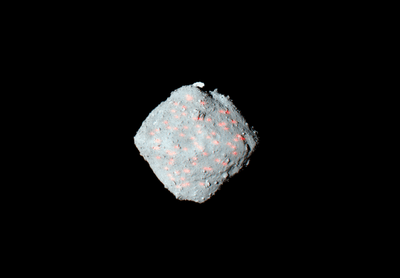


The Hayabusa2 mission from the Japanese Space Agency (JAXA) brought back samples of asteroid Ryugu, a nearby object of great interest. The mission was the first ever to collect return samples from the surface of an asteroid – and under the surface. New analysis shows significant differences between the two, which indicate that within the last millennium, Ryugu experienced an intense bombardment of micrometeoroids.
Even in the depths of space, things do not stay static. The effects of the solar wind, charged particles flowing from the Sun, can degrade the atmospheres and surfaces of celestial bodies in the Solar System. Elements such as sulfur and sodium are often classed in the volatiles group, substances that are blown away by the solar wind. Surprisingly, though, the surface of Ryugu is enriched in sodium.
There is five times more sodium on the surface of Ryugu than in its subsurface, and that is exciting for multiple reasons. Experiments suggest that the action of the solar wind should remove sodium from an exposed surface like that of Ryugu within a few centuries. Seeing an enrichment provides evidence that the asteroid must have experienced something that caused that.
The team proposed that within the last 1,000 years, Ryugu experienced a bombardment of micrometeoroids, an event that must have been quite intense. Across the surface of the asteroid, there is an extremely thin (about 10 nanometers) layer that is enriched in sodium and iron sulfides.
Analysis of the surface material strengthens the case for such an event. First of all, the surface sample appears to be more processed than the more primitive subsurface sample. There is glassy material, and there are mini-craters as well as grid-like features that are believed to have formed due to the interactions with the solar wind.
“These differences have already been observed in the literature when comparing samples collected on the surface with those from underground. Our work confirms this trend, highlighting significantly greater processing for the surface particle, in line with the expected models,” lead author Ernesto Palomba, from the Italian National Institute of Physics & Astrophysics (INAF), told Media INAF.
The team aims to conduct lab experiments with material more similar to what Ryugu is made of. The estimations in the research literature of how quickly an asteroid might lose sulfur and sodium due to the solar wind are based on what we know of asteroid Eros, a very different object.
Still, it is not truly surprising that Ryugu might have experienced such an event so recently. The Earth is believed to fly through about 1,200 meteoroid streams on its orbit. Near-Earth objects like Ryugu are also likely to encounter them on occasion. A possible scenario is that Ryugu crossed into a young dust tail that had not had time to disperse.
The study is published in The Astrophysical Journal Letters.