Space and Physics
 PUBLISHED
 1
1


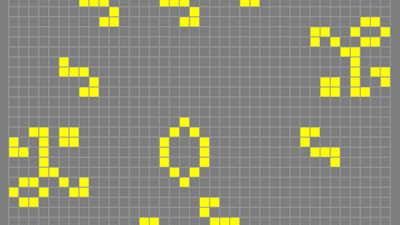


In 1970, British mathematician John Horton Conway created a zero-player videogame, dubbed "Conway's Game of Life".
The game takes place on a grid of squares, and the only input a user can have is setting the initial state, making it a far cry from Far Cry. The user sets the starting state of the grid – deciding which spaces are occupied and which are unoccupied – and then the game follows a few simple rules to determine the evolution of the grid. That sounds pretty dull, but the results are anything but.
The rules, decided by Conway, are as follows:
For a space that is occupied, each cell with one occupied neighbor or no neighbors dies, as if by solitude. Each occupied space with four or more neighbors also dies, as if by overpopulation. If an occupied cell has two or three neighbors, it will survive to the next step (i.e. it will remain occupied as the whole grid moves forward one step).
A space that is unoccupied, meanwhile, will only become populated only when it has three occupied spaces beside it.
So why is this fun and/or interesting? Following these simple rules, complexity arises. Patterns and oscillators emerged pretty quickly and were spotted by the gamers who played it. Repeating patterns soon came about too, with more complex interactions between the grid squares, including some patterns that only emerge and stabilize after many generations. For example, the "acorn" pattern of 7 occupied squares produces 13 gliders and only stabilizes after 5,206 generations.
Gliders are the smallest of the moving structures that emerge in the game of life, but there are other larger "spaceships" that appear within the chaos (play with one here). These ships self-replicate and move across the grid, while other patterns can produce "guns" (see one here), which create and send more gliders on their path.
There are also structures known as "eaters", which gobble up spaceships should they stray too close.
Using the game, with its simple rules, it is possible to create logic gates, allowing you to do calculations.
In fact, the game is "Turing complete", meaning that with the right starting pattern, it is possible to do any calculation that is possible on a traditional computer. Here, for instance, is Conway's game of life simulated by a computer within Conway's game of life.
The main takeaway from the game is not about life being possible in a 2D universe (although some physicists think that it is) but that complex patterns and behavior can emerge from very simple rules. That, and try not to get too close to The Eater.