Nature
 PUBLISHED


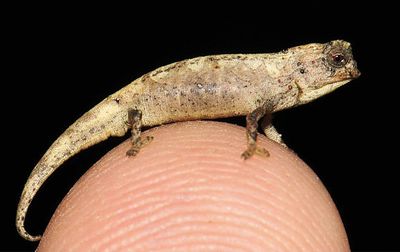


Camouflage is a valuable trait for both predator and prey, but it can be a bit of a pain in the butt for field biologists searching for unidentified species. The search becomes even more difficult when you’re dealing with an animal the size of your fingertip. Just ask the world’s smallest chameleon.
Small enough to perch on your fingertip, it was discovered by scientists back in 2021, who published their findings in Scientific Reports. So, how does one find a leaf-colored speck in an ocean of leaves?
“It takes a lot of patience and an eye for it,” co-author Mark D Scherz told IFLScience. “With practice, one can get relatively good at it, but we often work with local guides who are particular experts in finding these tiny chameleons as well.”
In 2012, the tiny chameleon Brookesia micra was documented for the first time. It was believed back then to be the smallest in the world, until an even smaller species came along to claim the crown. It was named Brookesia nana.
“'Nana' is derived from the same Latin/Greek root that gave us the prefix 'nano-',” explained Scherz, “Which we apply to things like 'nanotechnology' to indicate very small size.”
A fitting name, then, for the world’s smallest chameleon.
It could be argued that this species compensates for what it lacks in size with what the researchers describe as “surprisingly large” genitals. For safekeeping, male chameleons usually tuck in their genitals, which are called hemipenes. Occasionally a male may choose to “air out the bits” and flex them about, and they also get them out for mating. Amazingly, when out and proud, the hemipenes of B. nana are roughly 18.5 percent of its body size.
Exactly why these tiny chameleons are so blessed is difficult to determine but the researchers suspect it’s the result of females’ substantially larger body size.
In order to successfully reproduce, the males’ genitals need to be able to mechanically function with the genitals of the females, making bigger bits beneficial to the survival and genetic continuation of these animals.
B. nana’s hemipenes are one of the longest among the small chameleons, but it doesn’t quite take the top spot. Brookesia tuberculata, which is just 18.3 - 20.1 millimeters from snout-to-vent, has pipped it to the post with a built-in extension on the hemipenes that makes the whole package reach over 30 percent of the male body size. Impressive stuff.
This fun-sized chameleon was recovered in Madagascar, a veritable haven for biodiversity and a common source of new species. “We are constantly identifying new species from Madagascar and describing them,” Scherz said. “Even among the beautiful and charismatic chameleons, there is a huge amount that we still have to learn. Meanwhile, we are also working to understand the evolutionary processes that have given rise to Madagascar's incredible diversity, and the threats that diversity is facing.”
An earlier version of this article first appeared in 2021.