Nature
 PUBLISHED
 151
151




In 2007, Inuit whalers in Alaska made a surprising discovery. In the carcass of a whale, they found fragments of a weapon embedded in its flesh – but this wasn’t a modern piece of equipment. The harpoon was traced back to the 1900s, and after investigation, scientists estimated that the whale itself was around 115 years old, if not older.
Bowhead whales (Balaena mysticetus) were severely affected by the introduction of widespread commercial whaling that saw their numbers plummet to fewer than 3,000 members. It was effectively ended by 1921, a move that has seen the population grow to between 10,000 to 23,000 individuals.
The whaling ban doesn’t apply to subsistence hunts led by Indigenous Peoples along the western and northern coasts of Alaska, where bowhead whales have been a vital food source for millennia. It was during one of these subsistence hunts that an unusual discovery was made inside the body of a bowhead caught by Inuit whalers.
According to the New York Times, a biologist spotted the fragments as the whale was being carved up and sent it to a historian at the New Bedford Whaling Museum, John Bockstoce.
The harpoon was an exploding lance, a popular choice in New Bedford when it was the whaling capital of the world back in the late 1800s. The patented device enabled Bockstoce and colleagues to narrow down its deployment to sometime between 1885 and 1895, putting the whale at around 115 years old.
It was an unusual contribution to the growing body of evidence that bowhead whales, as well as being among the largest whales, exhibit exceptional longevity, possibly extending to over 200 years – making it the longest-living mammal on the planet.
How do you age a whale?
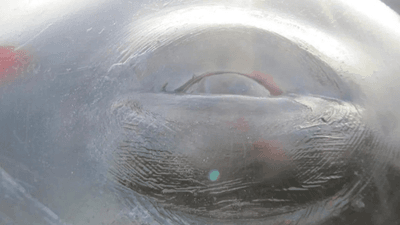
When you’re short on 1900s-era exploding lances, another way to age a whale is to look into their eyes. Here, you find the eye lens that contains aspartate, which can come in left- and right-handed variants. How that aspartate changes over time can reveal the age of an animal, as Dr Ariel Zeleznikow-Johnston explained in The Future Loves You: How And Why We Should Abolish Death.
“A baby bowhead whale starts with 100 percent left-handed aspartate in their eyes, but over time this will tend to an equilibrium of 50:50 left:right molecules. In a process similar to radiocarbon dating, examining the exact ration of left- to right-handed aspartate present in the lens can identify the age of an animal.”
As Zeleznikow-Johnston makes a case for in the book, sometimes long life can come at a cost, and for the bowhead whale, that includes tiny testicles. The genetic quirk gives the whales' cells time to heal before they duplicate, but it may have a negative impact on fertility.
An earlier version of this article first appeared in 2024.