Nature
 PUBLISHED
 2
2


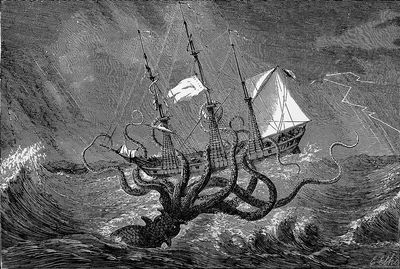


History is full of strange tales of tentacled sea beasts ravaging ships and terrifying sailors on the high seas. It’s easy to dismiss many of these as myth drummed up by drunken pirates, but there are credible, modern accounts of such attacks, too. Perhaps one of the most incredible incidents unfolded in the late 1970s just off the coast of California.
In 1978, the USS Stein, a US Navy frigate, set sail on its maiden voyage out of San Diego when the ship’s anti-sub sonar equipment suddenly went offline, forcing it to return to base.
Once it arrived back at the dry dock, Petty Officer Ira Carpenter went to inspect its sonar dome on the hull. To his surprise, he noticed a series of large cuts had shredded its rubber coating. A further inspection revealed the slashes were embedded with an unusual organic object.
"I'd never seen anything like this before, and this type of damage was brand new to me,” Carpenter said in an old interview shared by the US Naval Institute.
“I used my knife to pick out this foreign object out of the [...] coating, and it looked to me like a claw,” he added. “I quipped to my SW Officer, at the time: ‘Look here, it looks like we’ve been attacked by a bunch of small alligators’.”
Stumbling for answers, they sought the expertise of Dr Forrest Glenn Wood, a renowned marine biologist who worked with the US Navy, who concluded that a huge squid was most likely responsible for the damage.
"Squids do have claws similar to this. Nothing else that is known in the ocean has structures of this kind,” Wood commented.
He hastened to add: “This doesn’t rule out something that we haven’t found yet.”
It was not a mythical Kraken, nor Cthulhu, but most likely a colossal squid (Mesonychoteuthis hamiltoni), a species that can grow up to 7 meters (23 feet) in length and can weigh as much as 500 kilograms (1,100 lbs).
Very little is known about this mysterious squid since it's highly elusive and lives in the dark depths of the ocean. It wasn't until 2025 that scientists finally captured high-definition footage of a living Colossal Squid in its natural habitat. Until then, our only hard evidence of their existence came from carcasses washed ashore or the beaks left inside the bellies of sperm whales.
We do know, however, that this species is the only member of Cranchiidae family to have hooks on its tentacles, which are used to attack prey – and, apparently, American warships.
Still, the colossal squid doesn’t perfectly fit into this character profile. They’re generally thought to lurk in the Southern Ocean around Antarctica, not the sub-tropical waters of Southern California. Likewise, they usually stick to deep depths, far beyond where ship hulls cut through the water's surface.
Was this a rogue individual, sick or dying, that had strayed far from its cold-water home? Or perhaps, in a last hurrah, this elusive giant decided to secure its place in naval history by taking a swing at the US Navy.
An earlier version of this article was published in September 2022.