Humans
 PUBLISHED




In 1963, a Turkish man grew increasingly frustrated as his chickens kept disappearing without a trace. While renovating his home, he noticed a stubborn crack in one of the walls. Curious, he chipped away at it, only to reveal a narrow passageway stretching into the dark. It wasn’t the hideout of his missing poultry, but he had stumbled on the entrance to an ancient underground city.
This is the legendary story told to visitors of Derinkuyu, one of several underground cities scattered across Cappadocia in central Turkey.
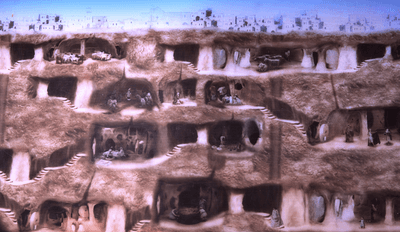
Carved into soft volcanic rock, the subterranean complex has 18 levels that plunge approximately 85 meters (278 feet) beneath the earth. The city evolved over centuries, shaped by the many cultures that occupied the region. At its peak, the labyrinthine complex would have been capable of sheltering up to 20,000 people.
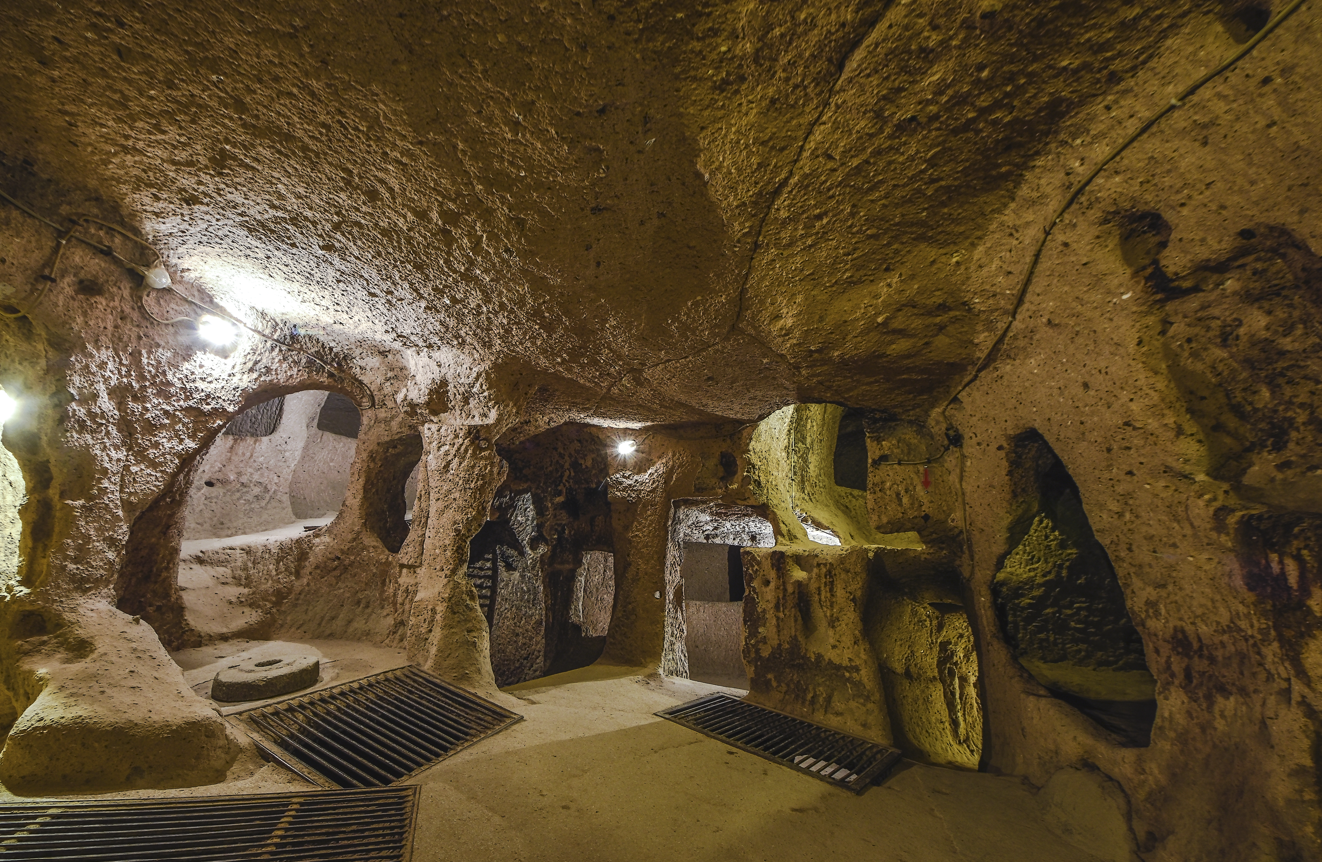
Far from a crude cavern, the underground complex was designed to support a fully functioning society for extended periods. Through the weaving nooks and crannies, there are countless rooms that served as meeting halls, stables, kitchens, storage areas, water wells, living spaces, weapon depots, wine cellars, burial tombs, and prisons. It even features dozens of ventilation shafts that allow fresh air to circulate deep into the pits of the maze-like structure.
The region of Anatolia, now modern-day Turkey, has always been prime geopolitical real estate, acting as a crossroads between Asia and Europe. Flanked by the Black and Mediterranean Seas, this strategic location fostered many rich cultures, but also attracted constant waves of invaders.
Given this context, historians believe Derinkuyu functioned primarily as a place of refuge during periods of war and persecution. Many claim it started with the Hittites, a culture that emerged in Anatolia around 3,600 years ago. Others reckon that the Phrygians might have built the site around 2,800 years ago. What’s more certain is that the underground tunnels were used by the Persian Achaemenid Empire, founded by Cyrus the Great in 550 BCE.
The walls of Derinkuyu are etched with the history of human resilience. Inscriptions and chapels indicate that Greek-speaking Christians used the tunnels to escape Roman persecution in the religion's fledgling decades. Centuries later, it was used as a hideout for Muslim Arabs during the Arab-Byzantine Wars between 780 and 1180 CE, before providing sanctuary for Christians once again in the wake of the Mongolian invasions in the 14th century CE.
Nowadays, the Derinkuyu underground city is a tourist attraction that visitors are welcome to see with their own eyes. Along with the other underground cities of Cappadocia, it is recognized as a UNESCO World Heritage Site.
Unfortunately, the Turkish man’s chickens have never been found.
An earlier version of this story was published in July 2025.

 1
1