Humans
 PUBLISHED
 6
6


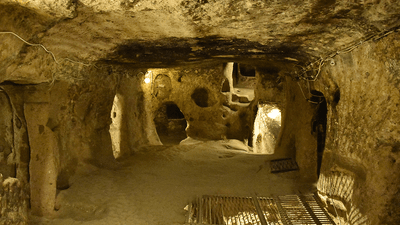


In 1963, a man in the Nevşehir Province of Turkey knocked down a wall in his basement and ended up discovering a gigantic underground city up to 18 stories deep, complete with chapels, schools, and stables. Known as Derinkuyu, the city had been abandoned for centuries – probably much to the relief of the man who'd just hammered his way in.
Work on the city, estimated to hold up to 20,000 people, may have begun as far back as the 8th–7th centuries BCE. The city is not the only one of its kind in the area – in fact, Kaymakli Underground City was connected to Derinkuyu through a series of underground tunnels.
Kaymakli, which stretches eight floors underground, is a little more modest than Derinkuyu, housing around 3,000 inhabitants. The top floor was used as a stables; the second floor down contained churches, graves, and living quarters; while the third was used for kitchens as well as storage and wine-making. In what sounds like a dystopian sci-fi concept, the wealthier families tended to live closer to the surface.
It was first excavated from the soft, volcanic rock around the 7th century BCE, but was expanded over the centuries, and used by early Christians to hide from religious persecution and attacks during the Arab–Byzantine wars of 780–1180. In the city, the top four floors of which are still accessible to the public, there are a number of large boulders that would have been used to block entrances to the city from enemies.
Amazingly, the city was not completely abandoned until 1923, when Greek residents of the area were forced out during a compulsory population exchange between Greece and Turkey.