Humans
 PUBLISHED



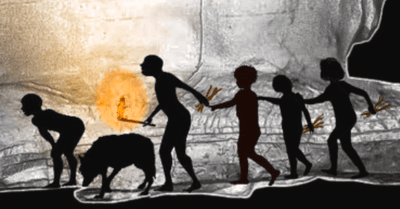


Imagine you’re on your way to a place called the Hall of Mysteries, which lies deep inside a dark, narrow cave infested with bears. Oh, and you’ve got your kids with you. At the very least, you’d need some sort of protection and something to light your way – which is why a group of prehistoric hunter-gatherers brought their dog and a bunch of purpose-dried pine torches when they made this very journey 14,400 years ago.
Known as the Grotta della Bàsura, the cave is located in the Liguria region of northern Italy and is full of bear skeletons and even a few traces of ancient bear fur. Its passageways also contain footprints left behind by five prehistoric humans from the Epigravettian culture – including at least one child – and a dog.
As well as representing the world’s earliest known evidence for dog domestication, these ancient prints also reveal the dangerous adventure embarked on by this intrepid group, who are thought to have spent about two hours inside the cave. During this time, they traveled about 400 meters (1,300 feet) from the entrance to the cavernous Hall of Mysteries before retracing their steps and returning to the light.
Researchers believe the dog was probably a trusty companion that came along to help protect the kids from bears or other threats lurking in the cavern. Charcoal remains on the walls and ceiling, meanwhile, suggest the group carried some sort of torch to light their way.
To determine the lighting system used by these prehistoric spelunkers, the authors of a new study began by analyzing ancient pollen found inside the Hall of Mysteries. Brought inside after getting caught in the bears’ fur, the pollen belongs to three different species of pine, indicating that pine forests dominated the local landscape at the time.
The team even found 56 small fragments of partially burned Scots pine twigs inside the cave. Importantly, none of these contained fungal mycelia, indicating that they hadn't been collected from the forest floor but were harvested from live trees and intentionally dried, probably for use as torches.
The researchers decided to also conduct their own experiments inside the cave, carefully traveling towards the Hall of Mysteries while igniting Scots pine twigs and branches to illuminate their way.
“As testified by human footprints, the behaviour of the five explorers, who proceed in all the cave in a single file accompanied by a canid staying close to the cave wall, is considered the safest approach also used by bears or wolves when moving in dark and unknown subterranean environments,” write the study authors. “In such condition, even a dim lighting would be sufficient to ensure view and safety of the entire group.”
During their experiments, the researchers found that “small branches 20-30 cm long are optimal for obtaining individual 'matches' that could be easily carried, even clamped between the teeth after lighting, to proceed on hands and knees and use both hands freely.” Using thick branches, meanwhile, proved impractical and produced a light so strong that it dazzled and blinded those carrying the torches.
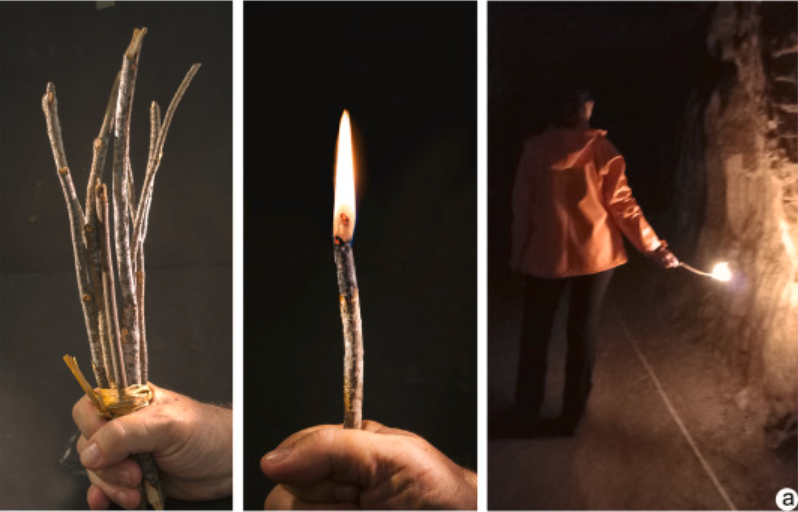
In the end, the ideal matches were those that burned through about 18 centimeters (seven inches) of length in four-and-a-half minutes, which is roughly the time it takes to move 100 meters (330 feet) through the cave. To reach the Hall of Mysteries, then, the ancient group would probably have stopped to relight their torches four times.
According to the researchers, the light of two torches would have been sufficient to illuminate the way for all five individuals and their dog. “The optimal situation is achieved when one torch is held by the second person in line and another by the last,” they write. Overall, then, the ancient group is likely to have used eight matches to reach the Hall of Mysteries and another eight to exit the cave, so they probably carried a bundle of these small pine twigs on their perilous underground adventure.
The study has been published in the journal Quaternary International.