Humans
 PUBLISHED
 3
3


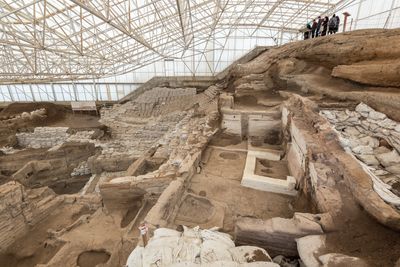


Dating around 9,400 years old, Çatalhöyük in present-day Turkey is home to some of the earliest surviving buildings ever built by human hands.
The many archeological levels of Çatalhöyük suggest that human activity started around 7,400 BCE and was maintained for over 2,000 years, according to UNESCO.
The only known site that’s older than this ancient proto-city settlement is Göbekli Tepe, which was built around 11,500 years ago. Both of these sites are located in modern-day southern Turkey, although they were likely built by two very different cultures.
This time period was a crucial chapter of the human story when people transitioned from nomadic hunter-gatherer groups to establishing agriculture. Archeologists generally believe that the organization and wealth of materials needed to build this kind of settlement could only be achieved after a society has mastered agriculture.
“Today we know that Çatalhöyük was not the earliest or the largest farming community in Anatolia and the Levant; however, it was a major participant in the cultural and economic changes that swept across the Near East in the Neolithic Period. Its strategic location in Anatolia made it a bridgehead for the spread of the Neolithic way of life to Europe and beyond,” explains UNESCO.

The site is described as a “streetless settlement of houses clustered back to back with roof access into the buildings.” This stands in comparison to Göbekli Tepe, which is thought to have primarily served as a temple used for ceremonies.
It’s a vast settlement, covering around 34 acres. Given this size, researchers believe it could have been home to a population of 3,000 to 8,000 people.
Animals clearly had considerable significance in the city. Animal bones in the area suggest that animals were domesticated here, mainly sheep and goats. Many of the walls are also covered in beautiful paintings that depict all kinds of paintings flesh-eating wild beasts.
Artworks of women are also common. One of the most impressive is the so-called Seated Woman of Çatalhöyük, a stunning baked-clay model of a nude female sitting on a throne, which has two hand rests in the shape of big cats. Scholars have previously interpreted the figure as a fertile Mother Goddess in the process of giving birth, although others believe it depicts an elderly local woman of high social status.

Çatalhöyük was first discovered in 1958 by a team led by British archeologist James Mellaart. After becoming entangled in a number of forgery scandals, Mellaart was banned from Turkey and research at the site was put on ice until the 1990s.
Thanks to the wealth of research that’s unfolded here, archeologists have built up a pretty decent picture of this magnificent place. Nevertheless, the ancient walls of this settlement still burst with mystery and intrigue.