Nature
 PUBLISHED
 6
6


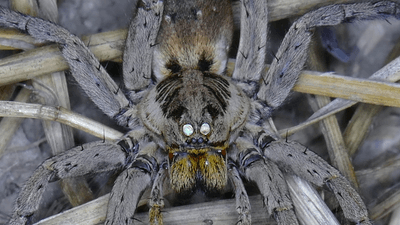


They say stare into the abyss and the abyss stares back, and no truer could that be than when you shine your light into a field or garden at night. You see, all those little dots of light reflecting back at you? There's a good chance they're spider eyes.
Safe in the shadows, they can scuttle among the grass unseen (by human eyes, at least) but shine a light and their peepers glow light cat’s eyes. Why? Because of a little thing called the tapetum lucidum.
Tapetum lucidum
The tapetum lucidum is why cats’ eyes glow. It’s also why great white sharks' eyes do, too. Oh, and it explains why reindeer eyes turn blue in winter. Clever little thing, the tapetum lucidum.
So, what is it? At the back of the eyes of many animals, you’ll find this “shining layer” that sits behind the retina, acting as a reflective trampoline. It effectively bounces light coming through the retina back in the direction of the photoreceptor cells, giving them a second chance at catching faint light.
Wolf spider eyes
The tapetum lucidum effect gives the owners of such peepers incredible night vision, and it's found in a wide range of species. It’s perhaps unsurprising, then, that it’s a trait shared by wolf spiders. And as for why their eyes glow at night? It’s all down to that flashlight in your hand.
“It reflects the light back out of the eye to the light source, making it look like the eyes are glowing,” according to the Sullivan County Conservation District. “Most wolf spiders (Lycosidae) hunt in the dimmer light of dusk and moonlight.”
“Their four large posterior eyes have well-developed tapeta, which help them spot prey movement in such low light conditions. At night, wolf spiders can be easily spotted because the tapeta in their large eyes shine brightly.”
So, if you’re staring out into your garden at night, flashlight in hand, and you see a sea of little lights shining back at you – act accordingly. You’re being watched.
Love spiders? Then you’ll be delighted to know we recently found what’s thought to be the world’s biggest web. The handiwork of around ~111,000 spiders, it’s big enough to catch a whale and is hidden away in a cave below the Albanian-Greek border. You can see photos of it here.