Nature



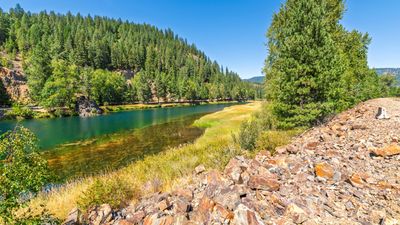


Idaho is famous for two things: gems and potatoes. If there had to be a third, though, perhaps silver would be a good choice. Since the late 1800s, more than 34,000 metric tonnes of the precious metal have been found in the state’s Silver Valley – that’s 37,500 US tons, or enough to fill about one-and-a-third Olympic-sized swimming pools – and now, thanks to work by researchers in Idaho and Washington, we know how it got there.
The area now known as the Belt Supergroup, the researchers conclude, owes its incredibly rich mineral deposits to a massive amount of salt water that was left behind some 1.2 billion years ago by the evaporation of ancient seas.
It’s a process whose legacy is still obvious, if you know where to look. “Even today certain layers of the Belt rocks still contain large amounts of salt, which has been stored in scapolite for over a billion years,” said Johannes Hämmerli at Washington State University, in a statement on the findings.
Back in the Mesoproterozoic Era, however – the so-called “boring billion” between around 1.8 and 0.8 billion years ago – as the rocks changed through extreme heat and pressure, not all the salt inside them was held in scapolite. Instead, heated by tectonic activity, it was flushed through the rocks as brine, forcing precious metal and mineral deposits into concentrated globs near the surface.
Most of this was already suspected – when you have a world-famous, continent-spanning, mineral-rich rock formation, it’s no great leap to suspect tectonic activity as the culprit. Similarly, the movement of ancient liquid through the rocks has long been floated – no pun intended – as an explanation for the patterns of ores and deposits found within them today, though researchers were less sure on that one.
It took the use of cutting-edge tech to solve the mystery. Using Washington State University’s electron probe micro-analyzer and laser ablation–inductively coupled plasma–mass spectrometer (a name that long and it doesn’t even have a good acronym? Come on, scientists), Isabelle Rein, now a PhD student at Purdue University, analyzed some of the Belt’s deposits of scapolite – a mineral which, she explained, “really […] record[s] its own history” by trapping chemicals from the fluids it forms in.
The results not only reveal what kind of fluid was present all those years ago, but also when and how it moved through the area’s geology. “[It] gives us a much clearer picture of how fluids evolved after sediment deposition in one of the world’s largest former basins and their role in transporting metals,” said Hämmerli.
Having cracked the case in Idaho, the team’s work may now help answer similar questions elsewhere in the world. “In exploration, you are always asking whether the system had the right fluids, the right timing, and the right pathways,” said Hämmerli.
“Once you know that, you can start looking for the same fluid fingerprints elsewhere.”
The study is published in the journal Chemical Geology.