Space and Physics
 PUBLISHED


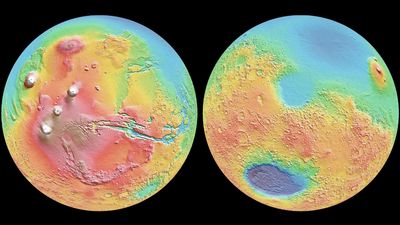


Since the first close-up observations of Mars, the ground of the Red Planet has revealed evidence of rivers, lakes, and more. The whole northern hemisphere of Mars is at a lower elevation, showing fewer craters than the southern. This suggested an ancient ocean, but the evidence for a shore was a bit muddled. New research drops that approach completely and finds a better way to showcase evidence of this bygone body of water.
The possible Martian ocean shorelines appeared to have wildly different elevations, with variations of kilometers. On top of that, on Earth, the location of shorelines changes significantly, some by tens of meters per year. The researchers ask behind the new study asked themselves if shorelines are the best topographic signature of an ocean. They came up with something better.
If people really want to search for oceans, they shouldn’t look for shorelines because they are not really good indicators. They move really fast, and that's why they're not even indicators of [ancient] lakes on Earth.
Dr Abdallah Zaki
Looking at data from our planet, Dr Abdallah Zaki, formerly of Caltech, and his then supervisor, Caltech professor of geology Michael Lamb, saw that while the shore changes, the continental shelf was pretty stable. The continental shelf is an underwater area spanning hundreds of kilometers that has a low value of curvature when it comes to elevation. Basically, it is a gentle, wide slope before the steep drop to the deep oceanic floor.
“We did do the same exercise on Mars, and we found that also we have a zone that has low values of slopes and curvature,” Dr Zaki, now at the University of Texas at Austin, told IFLScience.
“Within the zone that has low values of slopes and curvature, we found evidence of coastal deposits, deltas, and depositional rivers. This is common. You see, actually, the continental shelf [on Earth] has all these: it has deltas, it has coastal deposits, and it has some flowing deposits bloomed from the rivers globally.”
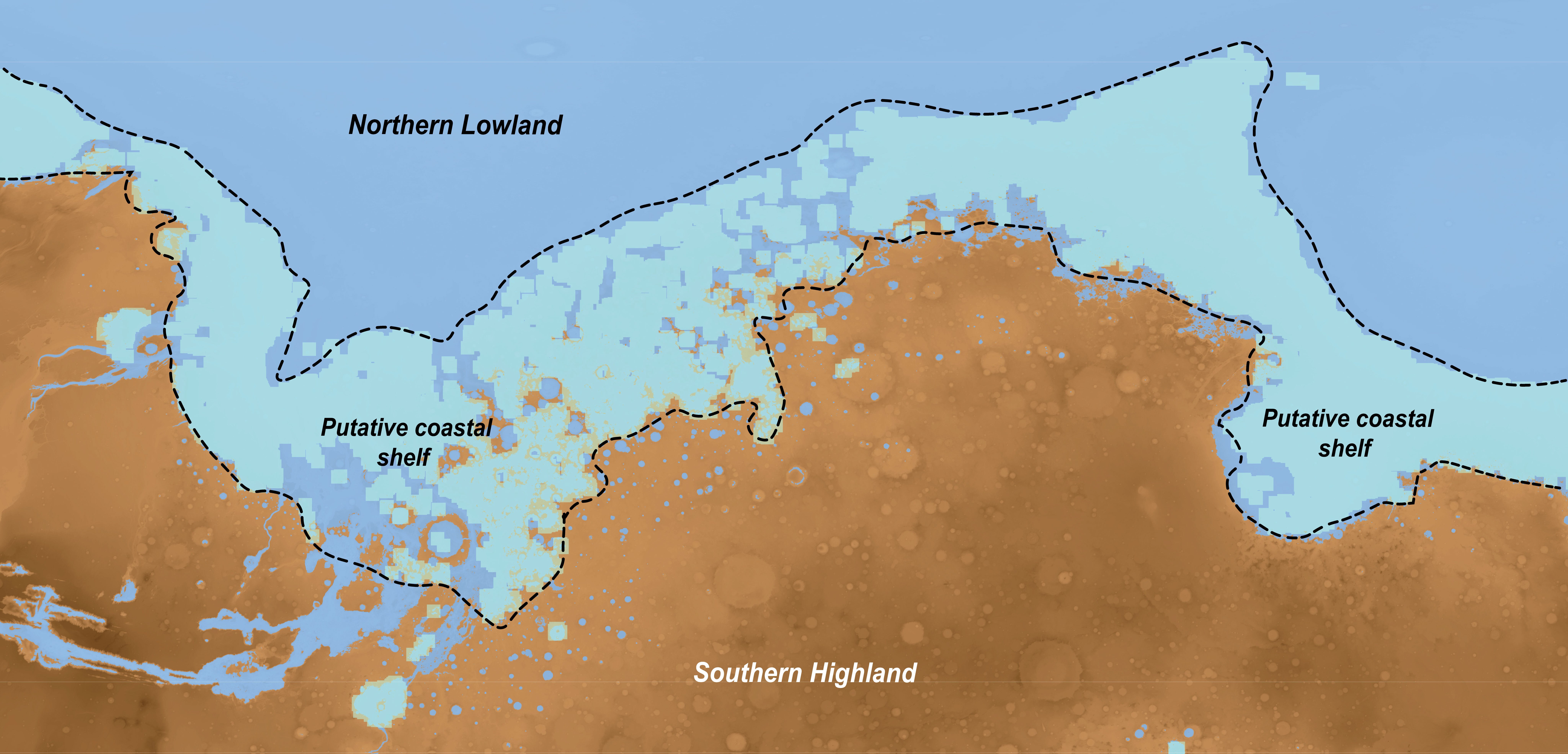
Mars has no tectonic plates, so there are no continents like those we have on Earth. Instead, this shelf is being dubbed a coastal shelf, and the team believed that it was a feature that took a very long time to form. The presence of this coastal shelf suggests an ocean that was stable for millions of years.
This finding has implications for the past habitability of Mars, as well as for where to look for ancient evidence for life; the coastal shelf may harbor the signatures of these hypothetical life forms. It has also given planetary scientists a new way to assess the presence of an ancient ocean.
“If people really want to search for oceans, they shouldn’t look for shorelines because they are not really good indicators. They move really fast, and that's why they're not even indicators of [ancient] lakes on Earth,” Dr Zaki told IFLScience.
“If you have your own planet and you want to search for your own ocean, don't look for shorelines; look for shelves.”
The study is published in the journal Nature.