Humans
 PUBLISHED
 6
6





Crowds work in mysterious ways, sometimes behaving more like a hive-minded superorganism than a collection of individuals. When viewed from above and afar, patterns emerge and large groups of people can be seen moving in complex yet predictable ways.
In a new study, scientists from the University of Tokyo and the University of Navarra have run a series of experiments showing that crowds of humans have a bizarre tendency to move in a counterclockwise direction. Why, however, remains something of a mystery.
In recent years, several studies have suggested that humans en masse have a strong bias toward moving in a collective counterclockwise direction. To test whether this theory held water, researchers held a bunch of carefully designed experiments, each tailored to probe a specific hypothesis related to the movement of human swarms and why we show a natural tendency to walk to the left.
The experiments
One involved asking 50 participants to move toward specific targets and perform certain tasks in a courtyard, while being watched by an overhead camera mounted 10 meters (32 feet) above the ground. Another tracked 107 Spanish teenagers moving around their schoolyard under drone surveillance. A third put Japanese college students in a cramped classroom laden with chairs. The researchers even observed a nursery school in Japan to determine just how instinctive this behaviour might be. A final experiment tracked the individual movements of 209 pedestrians as they navigated a university campus.
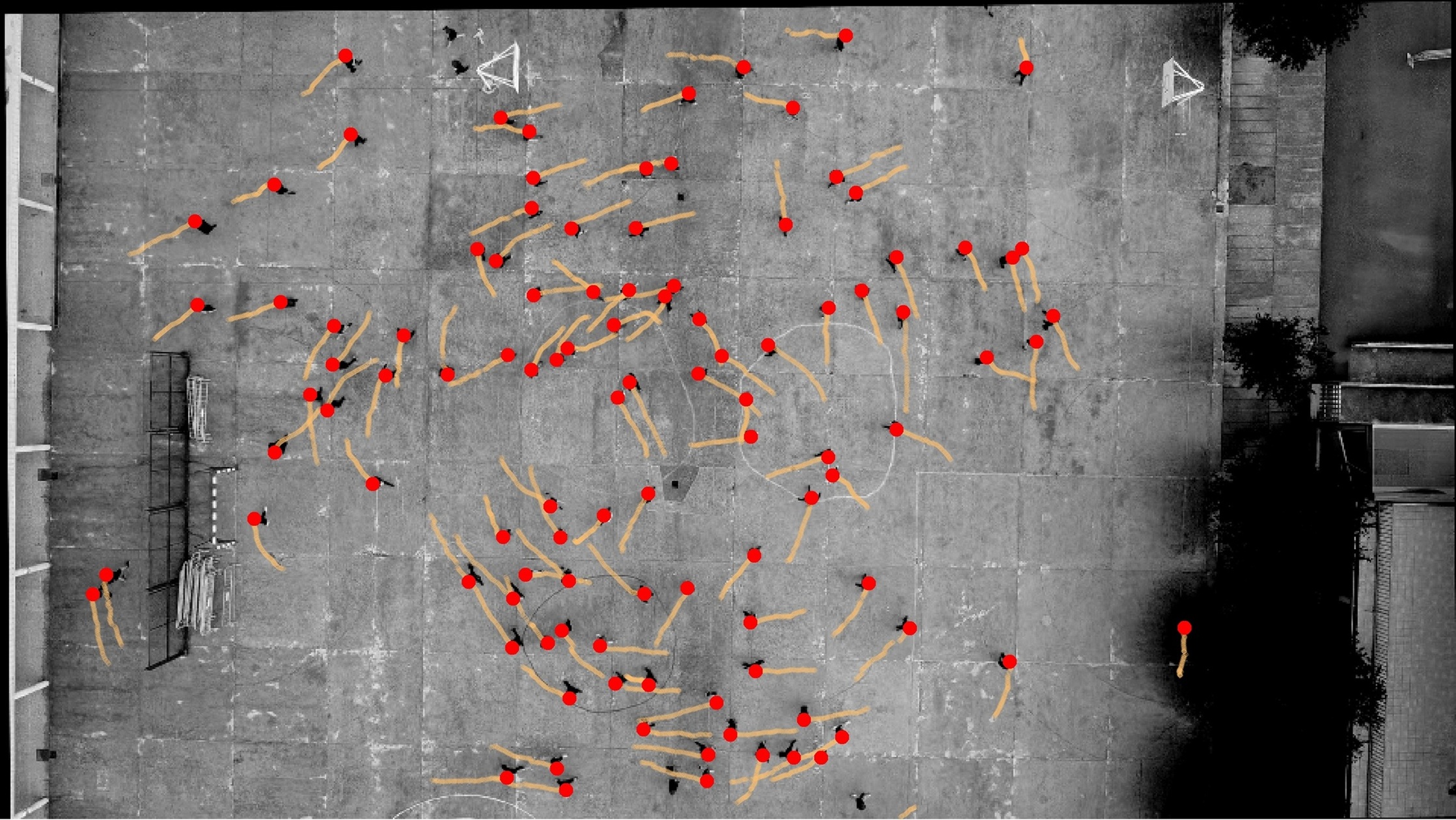
When the team analyzed the wealth of data, a clear preference for counterclockwise movement was seen.
"When analyzing the experiments, my colleagues realized by chance that in 32 out of 33 experimental trials, as people moved and turned, they noticeably preferred to turn counterclockwise," Project Associate Professor Claudio Feliciani, who was at the University of Tokyo's Department of Aeronautics and Astronautics at the time, said in a statement.
"This was completely unexpected as, at least instinctively, when people walk around randomly, you imagine people turn as their needs suit them, with little sign of an overall preference. But there was a definite, measurable tendency for people to turn counterclockwise over clockwise, all things being equal."
The analysis accounted for a range of factors that may have influenced the results, including participants' cultural background, group size, gender, left- or right-handedness, and age. The results remained consistent regardless.
“Of all these things, the only thing that stood out was that kids tend to have a stronger bias for the counterclockwise direction, so probably age plays a role in making the effect weaker or stronger,” explained Feliciani.
“Our results may appear as a minor insignificant discovery, but in nature, most phenomena related to locomotion show that animals mostly walk without directional preference. The strong bias found in people hints to some asymmetry at the biomechanical level.”
The long history of counterclockwise movement
This is an idea that’s deeply baked into many aspects of culture, whether you know it or not. Have you noticed how athletes always run anticlockwise around the track? It’s thought to have been that way since the Olympians of Ancient Greece and charioteers in Ancient Rome, aside from a few blips in history when athletes were forced to run in a clockwise fashion, but complained it didn’t feel right.
Why humans appear to be drawn to move this way remains unclear. The team has put forward several possible explanations – some wilder than others – but for now, it remains a mystery.
“It likely does not come from the eyes, because we tried to patch people’s left or the right eyes and the bias was still there. And some people asked us if it might be large-scale phenomena like the Coriolis force or Earth’s magnetic field, but this seems unlikely given what we have managed to point to so far,” said Feliciani.
“There are some interesting parallels to certain sports. Some running and driving competitions are always, but inexplicably, taken on courses that run counterclockwise. But that’s an investigation for another time,” he added.
The study is published in the journal Nature Communications.