Nature
 PUBLISHED


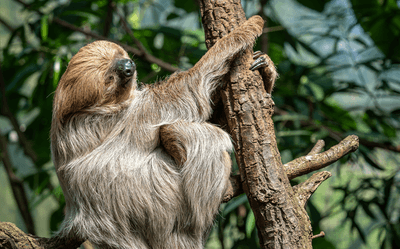


Amid the non-stop buzz of the jungle, the sloth uses a very unorthodox tactic. Rather than rushing around, using speed and agility to outdo rivals in a hyper-competitive environment, it slows things down to a comically slow pace. To find out how the sloth developed its extraordinarily sluggish behavior, scientists have taken a deep look at its genome and found the secret may lie in its “jumping genes.”
Their research focuses on the two-toed sloth, a slightly larger and marginally faster cousin of its three-toed counterpart. (Recent research suggests two-toed sloths are actually two separate species themselves.)
DNA was extracted from the tissues of a captive sloth at Tierpark Berlin and sequenced at the Max Planck Institute for Molecular Cell Biology and Genetics in Germany. Researchers from the Leibniz Institute for Zoo and Wildlife Research and the Wellcome Sanger Institute then compared its genetic makeup to other closely related mammals, including an anteater and an armadillo.
All three of these animals belong to the clade Xenarthra, a name derived from the Greek word xénos, meaning "strange" or "foreign." It's a bit of an outdated label from the 19th century, but it does highlight how distinct these South American mammals are from most others on Earth.
What did the study find?
Dare we say, sloths are the strangest of all Xenarthrans. The genetic analysis revealed that the sloth genome contains multiple active copies of transposable elements, AKA transposons or "jumping genes", which are mobile genetic elements capable of “copying and pasting” themselves at different positions in the genome.
Jumping genes are not uncommon in themselves, but Xenarthrans seem to utilize them in especially helpful ways. Sloths, in particular, possess a striking abundance of recent insertions, and dozens appear to have been long-ingrained into their genome, repurposed to do useful biological functions.
Many of those tasks are geared towards energy and metabolism. Some of them are linked to the mitochondria, the “powerhouses of the cell” responsible for generating the energy that drives complex life. By fine-tuning how cells produce and deal with energy, these mobile genetic elements are able to support the sloth's wonderfully listless way of life.
The researchers found these "jumping genes" emerged around 30 million years ago in the last common ancestor of all extant sloth species and, since they were favorable to their ongoing survival, they stuck around to this day.
“Evolution has already run billions of experiments. By studying unusual animals like sloths, we sometimes uncover biological solutions that humans never evolved," Dr Marcela Uliano-Silva, Senior Bioinformatician and co-lead author at the Wellcome Sanger Institute, said in a statement.
“Using genomics to look back through time, we found ‘jumping genes’ that sloths have conserved over millions of years. These sloth-specific genes are linked to mitochondria and metabolic pathways, suggesting they might be related to the evolution of their extremely slow metabolism," she added.
Beyond sloths: healthy aging, medicine and... space travel?
Like many studies of this ilk, the researchers say their work has much broader implications in the realm of human health. By taking notes on the sloth’s unique genetic quirks, they suggest, we may be able to inform the development of new treatments and drugs that keep certain diseases at bay.
“Many human conditions – including diabetes, aging-related disorders, neurodegeneration, and muscle wasting – involve problems with energy production and mitochondrial function. While further research is needed, sloth cell lines may offer a natural model for understanding how organisms cope with low-energy states, and what goes wrong in disease,” explained Dr Pedro Galante, co-lead author at the Hospital Sírio Libanês in São Paulo.
“In the long term, this could inform research into tissue preservation, critical care medicine, aging, metabolic disease, and even long-duration space travel."
The new study is published in the journal BMC Biology.