Nature
 PUBLISHED




Eyes come in just about every form in the animal world – from unusually shaped pupils, to bright colors, and even some animals that have evolved to do without. But what about the creatures that crawl across planet Earth? When you’re used to seeing the world from the safety of a web or from behind a trap door, does it matter how many eyes a spider has?
How many eyes does a spider have?
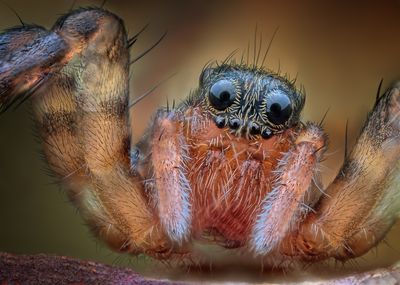
Typically, most spiders have eight eyes in four pairs. However some species have six eyes, like the brown recluse spiders, and some have only two or four, or only vestigial remains.
Despite having many more eyes that humans, spiders don’t really see all that well. Instead they rely much more on touch and vibrations, and in some cases even smells. It's important to remember that spiders number around 45,000 species and – most importantly – they are not insects but belong to the arachnids, a class of arthropods. Because of this variety, some spiders have evolved excellent vision, while some species have evolved to have no eyes at all.
How are spider eyes arranged?
Unlike insects, which have compound eyes, spiders have eyes similar to humans but with only a single lens (humans have two), according to Science News.
The largest central pair, or sometimes pairs, of eyes that are forward facing are called the primary eyes, known as anteromedial eyes or AME. Unlike something like an owl that can pivot its neck to see a wide field of view, spiders have eyes around their heads to give them a greater field of vision since they don't have a neck to turn.
Spider eyes are arranged on the sides of their heads to give protection from predators or to spot prey at different angles. These eyes are called secondary eyes and can be classified as anterolateral, posterolateral, or posteromedial eyes depending on their positioning on the side of the head.
A 2017 paper compared diagrams of different eye arrangements, showing the variety within different spider families.

What does the research on spider eyes say?
Scientific research has been done on the eyesight of jumping spiders. They have the typical arrangement of eight eyes in four pairs. However, jumping spiders have one of those pairs slightly enlarged, with two large eyes at the front of their heads and then more eyes around the sides that help detect when something is moving closer to them. Experiments have revealed just how important to the spider these eyes are, and have even found that they can recognize spiders they've met before.
Another experiment, this time with with net-casting spiders, revealed why they have such large eyes and even involved a spider blindfold.