


 Culture and Society
 PUBLISHED


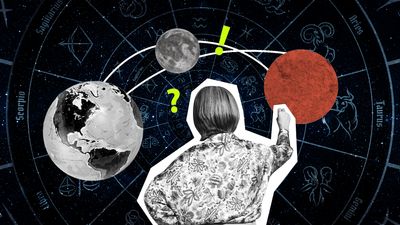


Pressed between two yellowing pages of an old notebook is a folded newspaper clipping I collected in 2008. Unfortunately, my younger self did not have the foresight to record the date of this particular piece from The Metro, a British freesheet tabloid newspaper, but it sits between two entries from June that year – so we may have a rough idea of when it was printed. This sloppy oversight is regrettable because this clipping came from the newspaper’s astrology section, and so knowing which day, month, and year would presumably be important for its significance.
Now I’ve never made a habit of reading the astrology section, but I remember looking at this one over the shoulder of a friend as we sat on a bustling London underground train. He was sniggering and looked completely baffled, despite being someone who actually enjoys astrology. And upon reading the entry, I understood why.
“What is causing you to form strong opinions about how something couldn’t possibly play a part in assisting you in some way?" the entry for Aquarius stated.
“The Sky insists that the solution you need is the one that appears least likely to be considered."
I kept this perplexing statement because it struck me, even 18 years ago, as a classic example of a type of slight-of-hand technique for making something trivial sound profound (by way of word stuffing). Expressed simply, the entry for Aquarius could have said “why do you think something is unhelpful? And have you considered coming at the problem from a different angle?” But I guess that lacks a certain flourish. It reads less like arcane insight and more like the type of advice someone down the pub might give if they couldn’t be bothered to engage with your problems.
Astrological beginnings
Astrology has been part of human culture for thousands of years. Although prehistoric humans probably made connections between the objects they saw in the night sky and their lives on Earth, the earliest recorded organized astrological system dates back to Mesopotamia, around the 3rd millennium BCE. This is when Babylonians started recording observations of the Sun, Moon, and planets and determining their influences on terrestrial events.
Over the long centuries, the practice has evolved in various ways across different cultures. Astrology has divined the rise and fall of kingdoms, predicted famines and droughts, and offered insights into political events that shaped nations. Bound up in this story is also the genesis of mathematics, astronomy (which was historically indistinguishable from astrology), and even medicine.
And yet today, this once-respected activity has become something altogether different. To some, it’s a trivial distraction typified by newspaper diviners or bombastic social influencers, while others ascribe to a more sophisticated view, treating the practice as a wellspring for psychological introspection and self-evaluation. And while many others may regard it as nothing more than pseudoscience – a vestigial artifact from an erroneous past – astrology is experiencing a substantial global resurgence. In fact, it has been estimated to be a $3 billion industry in the US alone and may well reach £22.8 billion globally by 2031.
It’s clearly worth taking a close look at what science says about this increasingly popular practice? And is there really any harm in following it even if it is not deemed scientific by current standards?
From predictions to personalities
One issue with astrology relates to just how historically contingent it is. Over the centuries, its methods, meanings, and purposes have all shifted significantly across cultures and time. Although this flexibility may have contributed to its long survival, it does raise questions about its legitimacy when it’s meant to be based on the supposedly fixed, consistent movements of celestial bodies.
As mentioned above, for centuries, astronomy was used to actively predict tangible real-world events; over time it shifted its focus to increasingly personal and eventually psychological matters.
“Historically, astrology was about prediction,” Carlos Orsi, journalist, science writer and, more recently, author of What Science Says About Astrology, told IFLScience. It was about people asking what's going to happen to them. Originally in Babylon or in earlier times, it was about what would happen to the state, how the crops would be affected by the seasons, if there was going to be a plague, whether the storms were going to be severe, or things like that.”
“Then it mutated along with the Greeks and then the Romans into personal predictions. What's going to happen to you? One of the biggest question people were asking in Roman periods was ‘when am I going to die?’”
But then astrology also became a political tool. During the Roman Empire, several emperors – including Augustus, Tiberius, Vitellius, Constantius II, and Honorius – either expelled astrologers from Rome or restricted their activities, particularly banning predictions about the emperor’s death. These measures aimed to prevent ambitious elites from using such forecasts to justify or plan coups.
When astrology was transmitted to medieval Europe from the Islamic world – where it had been greatly modified and expanded upon by generations of scholars – it became a pervasive and influential practice used in everyday decision-making. It was practiced by physicians, mathematicians, astronomers (still a conflated activity), and alchemists (early chemists). Astrologers became common features of royal courts, especially from the 14th to the 15th centuries, where they cast horoscopes for monarchs. As in the Roman period, this was a contentious practice, leading some rulers and popes to prohibit predictions about a monarch’s death during times of political instability.
The Renaissance witnessed a renewed interest in astrology – this was arguably the time of its cultural zenith. As tensions between Christian doctrine and emerging natural philosophy started to develop and be reconciled, astrology became increasingly popular for personal use. At the same time, ancient philosophical traditions, such as Neoplatonism, experienced a revival, encouraging the belief that humans could harness cosmic influences. Within this framework, astrology was a highly respected intellectual pursuit for large portions of society.
Ptolemy was a great astrologer. He created this big mathematical structure that allowed a geocentric universe to work. Of course it was wrong.
Carlos Orsi
Astrology’s influence gradually started to wane as the Scientific Revolution and the subsequent Age of Enlightenment progressed. Now deemed a pursuit of the credulous and the irrational, astrology was separated from astronomy, its scientifically grounded twin. It remained a fringe tradition from the end of the 17th century through to the latter part of the 19th century, when it experienced another resurgence. It is here that modern astrology was born.
In many ways, we have one individual to thank for this. William Frederick Alan, a British esotericist and entrepreneur who worked under the professional name of Alan Leo, played a substantial role in shaping 20th-century astrology to what we see today – the personality-oriented perspective. As a publisher of the magazine Modern Astrologer, the author of several books, and a lecturer, Leo was something of an authority on the subject. Leo helped champion a form of astrology that was based on a person’s Sun-sign – the sign of the Zodiac in which the Sun was at the time of their birth.
As familiar as we are with this concept today, this move represented a radical departure from nearly 2,000 years of European tradition. Emphasizing the Sun’s predominance was an excellent move for popularizing astronomy, as it made an otherwise sophisticated and complicated subject accessible for lay audiences. Leo was also an active Theosophist, a member of a 19th-century spiritual movement that sought to marry elements of religion, philosophy, and mysticism that believed in hidden divine knowledge and spiritual truths that united all religions. As such, his focus on the Sun as the main element of modern astrology infused it with theosophical spiritual and karmic concepts derived from Eastern esoteric traditions.
But above all, Leo’s rebranding of astrology to focus on psychology rather than prediction served a very practical purpose: it got around the law. Leo was consistently prosecuted by the law for “fortune-telling” under the Vagrancy Act of 1824. By pivoting towards psychological insights, Leo was able to continue popularizing a form of astrology that sidelined prediction for spiritual self-help.
“And it worked”, Orsi explained. “It helped astrologers navigate the fortune-telling law problem. It then evolved over the following decades, especially when the New Age movement came along in the 1960s and '70s, when [psychology] became the big motor of astrology’s popularity.”
The stars unaligned
Aside from being historically inconsistent, astrology has also suffered from another significant undermining issue: contrary to the beliefs that established it, the unchanging heavens have changed, and so too has our knowledge of the cosmos.
The Western zodiac originated with the Babylonians, who divided the path of the Sun into 12 equal sections corresponding to a yearly cycle. These divisions became the zodiac signs, which were later adopted and further developed by the ancient Greeks, who helped to standardize the constellation system and its associated symbols – Aries, Taurus, Gemini, Cancer, and so on.
If you project a line through the center of the Earth and the center of the Sun to see which stars this line will hit, they are not the stars the [early] astral charts say should be there.
Carlos Orsi
This was a geocentric model, meaning that the Babylonians believed the Earth sat at the center of the cosmos, with the Sun, stars and planets orbiting around it. During the 2nd century CE, a Greco-Egyptian scholar named Claudius Ptolemy refined and presented astrology as a rational system based on this same geocentric model.
“Ptolemy was a great astrologer," Orsi said. "He created this big mathematical structure that allowed a geocentric universe to work. Of course it was wrong.”
Ptolemy’s system formed the basis for understanding the movement of the celestial objects for centuries, but the geocentric model of the universe was eventually replaced by a heliocentric one – the Sun as the central point that the planets revolve around – during the 16th and 17th centuries. In particular, the observations made by Nicolaus Copernicus, Galileo Galilei, Johannes Kepler, and Isaac Newton all dismantled the Earth-centric views. Despite this significant shift in our conceptual place in the universe, Western astrology still relies on the conceptual framework established by Ptolemy.
Further to this significant problem is the fact that astrology hasn’t fully adapted to other astronomical changes, especially those related to the precision of the equinoxes.
The Earth’s axis doesn’t spin like a ball, it spins like a top, which means it wobbles. This wobble is caused by the gravitational pull of the Sun and the Moon, producing an uneven torque. Over time, this has led the Earth to effectively shift backwards through the constellations of the zodiac, moving about 30 degrees every 2,150 years.
“It's very slow, but it happens. So nowadays, if you project a line through the center of the Earth and the center of the Sun to see which stars this line will hit, they are not the stars the [early] astral charts say should be there.”
Despite this, most Western astrologers continue to use this fixed zodiac based on seasonal divisions, rather than the actual positions of the stars. So, if you’re an Aries (typically late March to April), based on current Western astrology, you should actually be a Pisces if you take into account the Earth’s current position relative to the constellations. But to Western astrologers, this is treated as a trivial issue.
You can kill a superhero in one movie and bring him back to life in the next while inventing some crazy explanation so the story can go on. Pseudosciences work the same way. They try to keep some kind of internal consistency, but it's superficial. They don't have the commitments to empirical reality.
Carlos Orsi
“It doesn't matter that the stars aren't there anymore," Orsi explained, because astrologers focus on “the section of the sky” where the constellations used to be. “It's fixed by definition," he says. But if you go to India, there’s a flavor of astrology being practiced that has been "corrected” to reflect these developments.
“It should be incompatible, from a practical point of view. But [Western astrologers] don't talk about it. And I think that's one of the things about astrology and other pseudosciences. I like to compare them to fictional universes, like those in superhero movies. They have this appearance of internal consistency, but they are completely imaginary.
"You can kill a superhero in one movie and bring him back to life in the next while inventing some crazy explanation so the story can go on. Pseudosciences work the same way. They try to keep some kind of internal consistency, but it's superficial. They don't have the commitments to empirical reality.”
Astrologers' nonsense
The above issues are just a few that impact astrology’s claims to legitimacy. There is also the issue of Uranus, Pluto, and Neptune, three planets that were not visible to the Babylonian, Vedic, or Greek scholars who established the original astral charts. However, their subsequent discovery and incorporation into astrology further demonstrate that it functions less as a system determined by the actual structure of the cosmos and more as a flexible, interpretative, and historically grounded framework. One that adapts to new discoveries after they’re made, rather than deriving its principles from them.
But all these issues are specific astrology as a system; they tell us less about modern astrology and its claims. Scientists have examined these too. One of the reasons why astrology is so compelling is that it appears to say something profound when actually it says very little at all. Consider the example I used at the start of this article, the author of that piece twisted a very inane statement into something unnecessarily complex with the hope that readers would interpret it as they saw fit.
“One thing I have to admire in astrology is how they perfected this power of producing statements that are generic and almost tautological, perhaps even meaningless, when they are enunciated, but became deeply personal when they are heard,” Orsi says.
“My favorite one goes like this: ‘you have potentialities that you still haven't been able to exploit to your own advantage.’ I mean, it's true for everybody, right?”
This tendency to find profundity in vague statements is known as the Barnum effect, a kind of psychological bias. Our brains naturally try to connect the dots to find meaning in random, general statements. Regardless of whether they are made in newspaper columns or online apps, the statements made by astrologers today consistently rely on this effect. And as astrology becomes increasingly popular – which tends to happen in times of uncertainty – it can cause problems. And our times are certainly uncertain.
“We live in a very crazy world, right? Things are changing all the time. We had a pandemic and now we have the threat of AI. Now we have crazy people starting wars all over the place. So I think that this sense of being adrift in a fast-changing world makes astrology more popular – it offers an illusion of structure," Orsi told IFLScience.
I think pseudoscience is something that tries to convince you that they are as relevant to understanding reality as science. Why do we take science seriously? Because you can't ignore science, right? You can't build a building ignoring the laws of physics.
Carlos Orsi
But contrary to what some may think, there are dangers associated with ascribing to these systems.
“I think we always have to be cautious with pseudosciences. I think pseudoscience is something that tries to convince you that they are as relevant to understanding reality as science. Why do we take science seriously? Because you can't ignore science, right? You can't build a building ignoring the laws of physics. And pseudoscience tries to convince you that they are just as important – ‘you can't ignore me if you want to be responsible or happy.' " Orsi said.
“When it comes to astrology, we have the data that shows it can be harmful," Orsi notes.
In 2020, researchers found that when Western astrological signs were introduced into China, it created negative stereotypes of Virgos who were discriminated against when it came to dating or finding jobs. In one study, Chinese hiring managers were less willing to hire a candidate labeled as a Virgo than an identical candidate labeled as a Leo.
“It can also justify irrational behavior, such as the case of Linda Goodman," Orsi explained. "She was one of the people, the biggest responsible for really turning astrology into a pop culture phenomenon, into a mass media phenomenon. She wrote two or three bestselling books in the '70s, explaining astrology for the general population. She had a daughter who committed suicide, but she was never able to see her body. She refused to believe the girl had died because her horoscope told her she was still alive.”
“She spent hundreds of thousands of dollars hiring detectives to find her.”
If Goodman hadn’t believed in astrology, would she have accepted her daughter’s death? It is impossible to say for certain, but it is clear that astrology provided her with an unhealthy hook to hang her delusions upon. Of course, not everyone who reads a newspaper horoscope or downloads an astrology app will experience this, but we have to remember they are still based on fiction.

 1
1