Space and Physics
 PUBLISHED



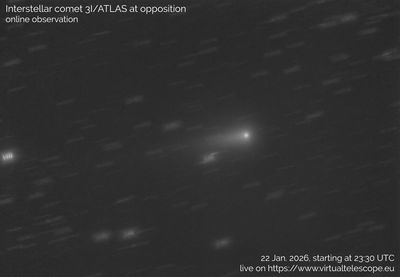


All good things end. Since July 1 last year, we have been delighted by knowing an interstellar comet was crossing the Solar System. Telescopes on and around Earth, spacecraft across the Solar System, and even Martian rovers have looked at this fascinating object. Now, it is time to start saying goodbye, at least for some of us.
The comet is getting dimmer and dimmer. It is moving away from the Sun and Earth, so its activity is weakening, and it is getting smaller in the sky. It has a magnitude of around 15 now, which is roughly the limit of what most amateur telescopes can capture.
Comet 3I/ATLAS is reaching opposition on January 22. This means that the comet, the Earth, and the Sun are roughly in a line, with the Sun in the middle. When planets in the Solar System are in opposition, it means that they are at their brightest, being the closest to Earth at that point and getting their full disk illuminated.
It is not the same for comets. 3I/ATLAS's peak of activity happened when it got at its closest distance to the Sun at the end of October 2025, and while the Earth got closer to the comet for the following several weeks, the interstellar interloper was flying away from our star, getting cooler and cooler.
If you do not have a telescope to catch the last few days of comet 3I/ATLAS being visible, worry not. The team at the Virtual Telescope Project is doing a livestream on January 22, starting at 18:30 EST (23:30 UTC).
This might not be the end for professional observatories, which could continue to keep an eye on it for a while longer, and there may be some observations from another spacecraft. Comet 3I/ATLAS will fly by Jupiter on March 16, 2026, and the Juno mission orbiting Jupiter could be used to snap a picture, as other missions have done from Mars and deep space.
The science on this fascinating object is not done; missions like Europa Clipper and JUICE, both bound for the Jovian system, have collected data already, but the full analysis will be completed in the coming months.

 1
1