Nature
 PUBLISHED

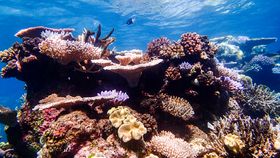


The Australian Institute of Marine Science has released the latest report on the state of the coral reef system as part of its long-term monitoring program and it's a depressing read. A deadly mix of cyclones, coral bleachings, and crown-of-thorns starfish outbreaks appear to have made an indelible mark on the world wonder, with more than half of coral lost in some regions.
The government-backed agency publishes an annual summary report on coral reef conditions, visiting each reef along the Queensland coast once every two years and using data collected by manta tows. The paper published Tuesday focused on reefs in the central and southern sections, which means it does not take into consideration the full impact of Tropical Cyclone Debbie and coral bleaching in 2017 on the northern region.
Reefs in the central section suffered coral bleaching and crown-of-thorns starfish outbreaks. Traditionally, coral coverage in this region is more sparse than elsewhere in the Great Barrier Reef but it still experienced a significant decline over a two year period, from 22 percent in 2016 to 14 percent in 2018.
The southern region has seen some recovery in the last two years. However, the researchers noted an overall decline in mean coral coverage between 2017 and 2018 (from 33 percent to 25 percent) for the first time in seven years.
Yet, it is the northern section that is the most affected by climate-induced marine heatwaves and it is here that roughly half of coral has been lost since 2016, according to a recent study. Mean coverage was just 10 percent in 2017. The report says that this is the first time it has been this low in the thirty plus year the long-term monitoring program has been running. In the worst affected regions, a jaw-dropping 90 percent of living coral has been lost.
"Major bleaching events in successive years have not been seen on the GBR before 2016 and 2017," the report authors write. "Over the 30+ years of monitoring by AIMS, GBR reefs have shown their ability to recover after disturbances, but such ‘resilience’ clearly has limits."
And the effects of climate change is only likely to exacerbate and accelerate these changes.
"The predicted consequences of climate change include more powerful storms and more frequent and more intense bleaching events," the report continues. "More intense disturbances mean greater damage to reefs, so recovery must take longer if the growth rate remains the same."
There's also the fact that the climate change is lessening the time between major disturbances and resulting in rising ocean temperatures, which can slow down recovery.
The authors point out that damage to breeding populations means fewer larvae to recolonize the reefs – which may mean we may become more reliant on coral transplant programs.
The Australian government has pledged $500 million to save the reef but there are doubts on how well that money will be spent.