Space and Physics
 PUBLISHED
 1
1



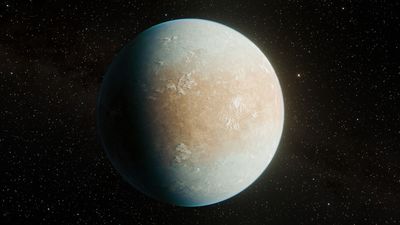


There is some bias in the way we are discovering exoplanets. The methods to confirm the existence of another world require tracking a candidate planet over several rotations around its star and measuring dips in light when the world creates a little eclipse. This means that bigger and closer planets are preferentially found. Finding an Earth-size planet, at roughly our distance from a roughly similar star, requires years of work. Still, they ought to be out there – and one might have just been found.
The object is a candidate exoplanet, so let’s be excited, but also know that it is not a definite discovery yet. However, the team saw one transit, and the data is very good, making them optimistic that they are seeing something real. If it is indeed a planet, it orbits star HD 137010, an orange sun, a bit dimmer and cooler than our own. The planet, HD 137010 b, has a radius very close to Earth’s own, it has a roughly circular orbit, just like Earth, and it goes around its star in as little as 300 days or as much as 555 days.
“This is the first planet candidate with Earth-like radius and orbital properties transiting a Sun-like star bright enough for substantial follow-up observations,” the paper describing the finding states.
It is an exciting possibility, very worthy of follow-ups. Due to the dimmer, cooler star, the planet gets about one-third of Earth’s sunlight. It is likely that this is a very frosty world, if it exists. The planet has a 50/50 chance of being outside the habitable zone of this system. That said, the team has simulated scenarios where a planet such as this can be habitable.
If the world has an atmosphere richer in carbon dioxide, then models are marginally more optimistic in that case. So, if this world is out there, the chance that it is Earth-like is small. We do not chase Earth-sized worlds just for their similarities to our planet. At the same time, we have one example of life in the universe, and it’s here, so starting with what we know to be familiar is the best shot.
Due to the orbital period, spotting more transits will be a bit difficult. Still, there is the possibility of follow-up with current observatories, such as NASA’s TESS (Transiting Exoplanet Survey Satellite) and ESA’s CHEOPS (CHaracterising ExOPlanets Satellite), or upcoming ESA observatories such as Plato and Ariel.
The study is published in The Astrophysical Journal Letters.