Nature
 PUBLISHED


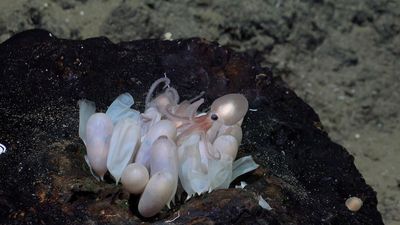


Down in the deep ocean off the coast of Costa Rica scientists have discovered, not one, not two, not three, but four new species of deep-sea octopus in a 259-square-kilometer area (100 square miles).
These new species live in seamounts in and around hydrothermal springs that were discovered in 2023. These areas contain octopus nurseries that have been found to be active all year round. One of the new species is in the genus Muusoctopus, and will be called the Dorado octopus after the area in which it was found, a small rocky outcrop nicknamed El Dorado Hill. This species was the only one of the new four to be found brooding its eggs in warm springs on the seafloor.

“Through hard work, our team discovered new hydrothermal springs offshore Costa Rica and confirmed that they host nurseries of deep-sea octopus and unique biodiversity,” said Dr Beth Orcutt, of the Bigelow Laboratory for Ocean Sciences, in a statement sent to IFLScience.
These observations were made by a team from Schmidt Ocean Institute onboard R/V Falkor (too). In total, over 160 deep-sea animal specimens will be archived in the Museum of Zoology at the University of Costa Rica, adding to an existing collection of specimens numbering around 150 from an expedition last June.
These collections mark the first time the specimens will be kept in the Central American country where they were collected, rather than being sent to the United States or housed somewhere in Europe. Keeping them in Costa Rica also allows scientists to access the specimens easily, helping to inform management decisions surrounding this deep-sea habitat.
“The impact of the R/V Falkor (too) expeditions on understanding the deep Pacific waters of Costa Rica will last into the future and hopefully create awareness that evolves into policies to protect the deep sea of the country,” said Dr Jorge Cortés of the University of Costa Rica. “I hope that the expedition serves as an inspiration for new generations. We need more international collaborations to advance knowledge of our deep-sea heritage.”
As well as the four octopus species, the team discovered a skate nursery, calling it the Skate Park, also off the coast of Costa Rica. Three more hydrothermal springs with different fluid temperatures and chemistries were also found in the area, 10 to 30 nautical miles from each other.

“Drs. Cortés and Orcutt formed a team that truly exemplifies international collaboration which empowers scientists within Costa Rica and enriches local knowledge and understanding of the ocean," said Schmidt Ocean Institute’s Executive Director, Dr. Jyotika Virman