Nature
 PUBLISHED


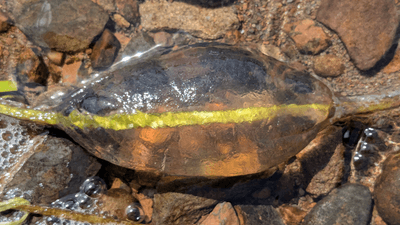


We all remember pond dipping as a child. Your first ever shot at fieldwork, dunking in a net and having a look at what got scooped inside. You probably would have screamed had you caught a freshwater bryozoan, mind you.
These enormous gelatinous blobs have been found by wary travelers in lakes and other bodies of freshwater. Scoop up a big lump of bryozoan and you’re not holding one animal, but hundreds wrapped up in a water-rich, gelatinous material. They start out life alone but eventually band together as colonial organisms that the US Fish & Wildlife Service reports have lived on Earth for around 500 million years.
Individuals are known as zooids and they have a pretty simple body plan. Imagine a microscopic grape with a mouth and an anus and you’re not far off. They lack respiratory, excretory, or circulatory systems, according to Delaware.gov, but they do have a central nerve ganglion that enables them to react to stimuli. Don’t be expecting much in the way of a reaction if you say hello, but it’s enough to enable them to feed using a crown of tentacles covered in tiny hair-like cilia.
Few people would rejoice at sticking their hand into water and touching miscellaneous goo, but freshwater bryozoans are usually something to celebrate. For starters, of the nearly 5,000 species that have been identified only around 90 live in freshwater habitats. So, congratulations, my jelly-handed friend – you have been blessed by the bryozoan ratio.
Moss animals, as they're sometimes known, are also cause for celebration because they can be an indicator of a healthy ecosystem.
“The bryozoan can be found commonly on docks, sticks and other underwater structures,” said Rebecca Downey, J. Strom Thurmond Project Office natural resource specialist, to the US Army Corps of Engineers. “These harmless, aquatic invertebrates live in colonies and are nature’s natural water filter. They are signs of clean water quality and are sometimes food to many snails, insects, and fish.”
They can travel far and wide in the guts of waterfowl or fish, or hitchhiking on aquatic plants, and sometimes crop up places people would rather they didn’t. Some species like Pectinatella magnifica have become established as invasive in Europe, Asia, and parts of the US. Even native species can cause problems if they set up camp inside inflow and outflow pipes, but jelly things do love to clog. Just look at the salps that brought two nuclear reactors to their knees.
Fortunately, the issue of bryozoans in the wrong place is a much easier one to deal with.
“They can be easily removed from surfaces by scraping them off,” said Downey. “Also, the colonies usually start to die off in the fall when the weather begins to cool and will likely be completely gone by the wintertime. But we are happy to know they are currently thriving in our lakes.”
So fear not, frightened Internet user who just touched miscellaneous goo and is trying to figure out if they’re about to die. The bryozoans are just doing their thing.